Guides
What Should a Small Business Website Include in 2026?
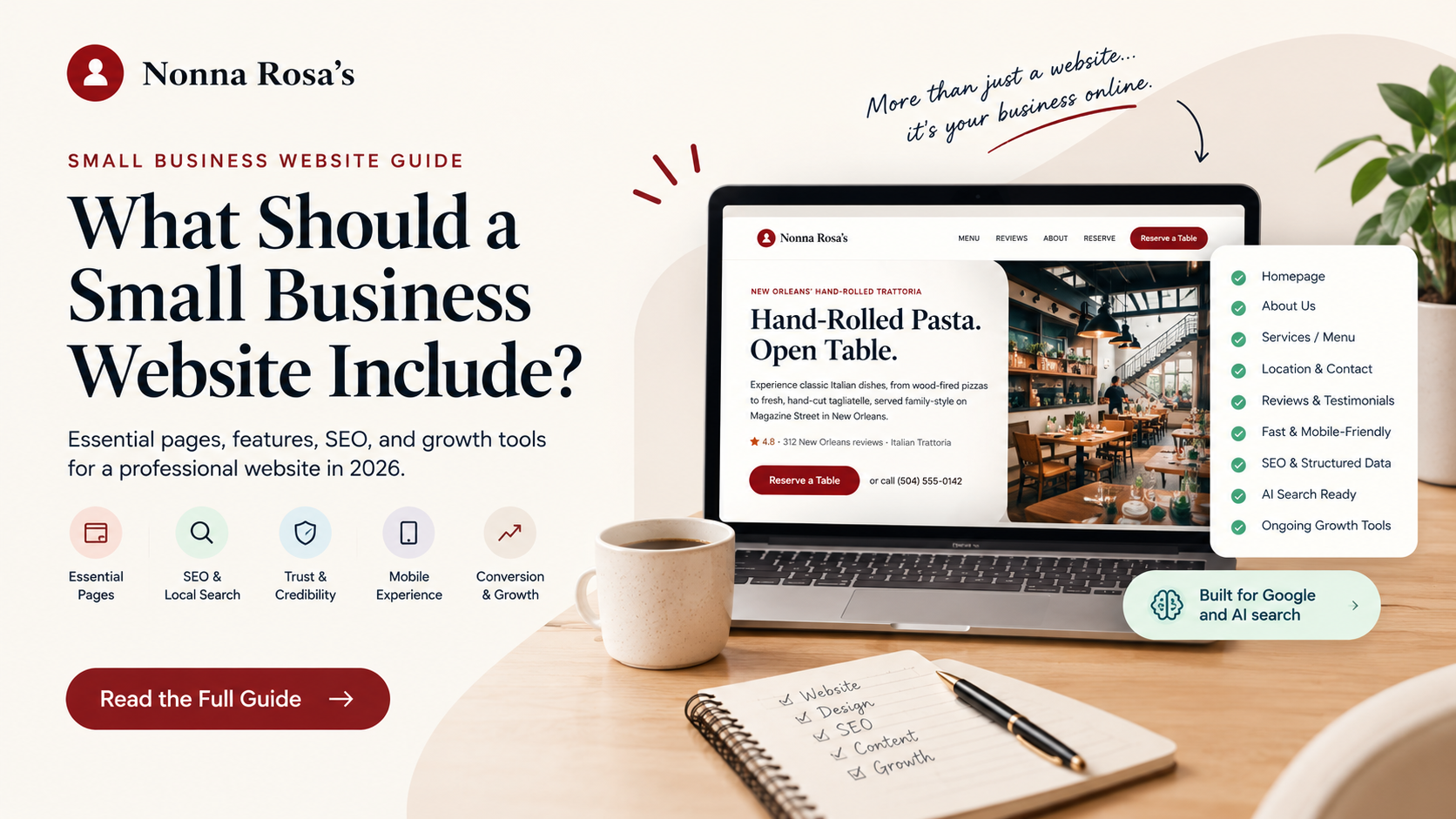
The essential pages, features, SEO foundations and growth tools a professional business website needs
A small business website doesn't need to be complicated.
But it does need to do its job.
When someone lands on your website, they should be able to answer a few basic questions almost immediately:
What do you do?
Where do you operate?
Why should I trust you?
What can I buy, book or ask about?
What should I do next?
And increasingly, there is another question:
Can Google and AI search systems understand your business accurately?
That's what makes a good small business website different from a collection of attractive pages.
The design matters.
But clarity, trust, usability, search visibility and action matter more.
So let's break down what a professional small business website should actually include in 2026 — and then look at how different SiteNeuro options approach those needs.
---
Think of your website as your business's digital front door.
It should be welcoming.
It should be easy to navigate.
And most importantly, visitors shouldn't have to figure out what you're trying to tell them.
A strong small business website typically has six foundations:
Clear positioning — what you do and who you serve Useful information — services, products, location, hours and contact details Trust — reviews, credentials, experience, photos and proof Conversion — calls, bookings, enquiries, purchases or another clear next step Search visibility — technical SEO and content that search engines can understand Performance — fast, mobile-friendly and accessible
This isn't just theory.
Google's documentation specifically recommends structured data for local businesses because it can help Google understand information such as business details, hours and other attributes. Google also recommends submitting a sitemap and making pages accessible for crawling and indexing.
And established website platforms make many of the same fundamentals part of their small-business offering: domains, hosting, mobile-friendly design, services, contact information, bookings, ecommerce and SEO tools.
The interesting part is what you do after the basics.
---
Your homepage has one major job:
Make the visitor understand where they are.
A good hero section usually communicates:
What you do
Don't make people decode clever marketing language.
“Emergency plumbing services in Austin” is clearer than “Solutions for modern living.”
Who you serve
A local customer should know they're in the right place.
Where you operate
For local businesses, city, neighborhood or service area can be important context.
What to do next
Call.
Book.
Get a quote.
Visit.
Shop.
Contact.
There can be other actions, but there should usually be one obvious primary action.
---
Your website should answer:
“What can I get from you?”
That sounds obvious, yet many small business websites bury their actual services beneath generic brand language.
A good services section should make it easy to understand:
What you offer Who it's for What each service includes Where it's available How to get started Pricing, where appropriate
For ecommerce businesses, that may become product categories and product pages.
For a lawyer, it may be practice areas.
For a restaurant, a menu.
For a consultant, services and areas of expertise.
For a dentist, treatments.
The structure should reflect the business.
---
People buy from businesses they trust.
That doesn't mean your About page needs to be an autobiography.
It means it should answer:
Why should I trust you with this?
Depending on the business, that could include:
Experience Qualifications Certifications Team members Years in business Awards Client results Professional memberships Founder story Relevant credentials
For professionals, this becomes even more important.
A consultant, lawyer, financial advisor, coach or engineer may be selling expertise and reputation, not a physical product.
Your website should make that expertise easy to understand.
---
This is one of the easiest places for a small business website to become generic.
Stock photography can make a website look polished.
But real business information makes it believable.
Consider including:
Real business photos Team photos Product photography Before-and-after examples Customer testimonials Google reviews Ratings Case studies * Portfolio work
For local businesses, your Google Business Profile can already contain valuable information such as photos, reviews, ratings, services and location.
Your website shouldn't ignore that information.
It should turn it into useful website content.
---
A website isn't a brochure if you expect it to generate business.
Give visitors a clear way to take the next step.
Depending on the business, that could mean:
Call now Book an appointment Request a quote Send a message Get directions Buy online Schedule a consultation Join the email list
For local businesses, phone numbers, addresses, hours and directions can be particularly important.
For service businesses, booking and lead forms can matter more.
For ecommerce, the conversion path may simply be:
Product → Cart → Checkout
The best website feature isn't necessarily the most sophisticated one.
It's the one that matches how customers actually buy from you.
---
Here's a simple test.
Open your website on your phone.
Can you understand the business without zooming?
Can you tap the main button easily?
Can you read the text?
Can you find the phone number?
Can you navigate without fighting the interface?
If not, the desktop design doesn't matter much.
A good small business website should be fast, readable and easy to use on a phone.
Speed also matters because a beautiful website that takes forever to load isn't a particularly useful website.
---
This is where many “SEO-friendly” websites stop too early.
SEO isn't simply putting “best dentist in Miami” into a paragraph twenty times.
A search-friendly website should have a coherent structure.
That can include:
Descriptive page titles Useful meta descriptions Clear heading hierarchy Descriptive URLs Image alt text Internal links XML sitemap Crawlable pages Structured data LocalBusiness markup where appropriate Fast mobile performance Clear service and location information * Useful, original content
Google's LocalBusiness structured-data guidance specifically identifies information such as business hours and other business details that can be communicated to Google in structured form.
The goal isn't to “trick Google.”
It's to make your business easier to understand.
---
This is one of the biggest changes in the website landscape.
Someone may no longer search:
“dentist near me”
They might ask an AI assistant:
“Who are some highly rated dentists near downtown who accept new patients?”
Or:
“Find a local accountant who specializes in small businesses.”
That creates a different challenge.
Your website needs to communicate information clearly enough that search systems and AI assistants can understand:
Who you are.
What you offer.
Where you operate.
Who you serve.
What makes you relevant to a particular question.
That doesn't mean adding keywords everywhere.
It means creating a website with clear, structured, useful information.
---
This is where the website conversation gets interesting.
Building the website is one project.
Keeping the business visible is another.
A website may launch beautifully and then remain untouched for two years.
Meanwhile:
Services change Prices change New reviews arrive New questions appear Competitors publish content Search behavior changes New products are introduced Google changes its search experience
A website can therefore be technically “finished” while the business's online presence slowly becomes outdated.
This is why some businesses need more than a website.
They need an ongoing growth system.
---
| Area | What a good website should provide |
|---|---|
| Positioning | Clear business, service and audience information |
| Pages | Home, About, Services/Products, Contact and relevant industry pages |
| Trust | Reviews, testimonials, credentials, photos and proof |
| Conversion | Call, book, buy, enquire or another clear CTA |
| Mobile | Responsive, readable, thumb-friendly experience |
| Performance | Fast loading and technically sound pages |
| SEO | Titles, descriptions, headings, internal links, sitemap and structured data |
| Local SEO | Location, service area, business details and LocalBusiness markup where appropriate |
| AI search | Clear, structured, answer-ready business information |
| Content | Useful pages, FAQs and potentially ongoing articles |
| Maintenance | Easy updates to information, photos, services and offers |
| Growth | Analytics, content creation, lead capture and ongoing optimization where needed |
The key word is needed.
A five-person accounting firm doesn't necessarily need the same website system as a 50-location restaurant chain.
---
This is where SiteNeuro takes a somewhat different approach.
Instead of treating the website as the entire product, SiteNeuro treats it as the starting point.
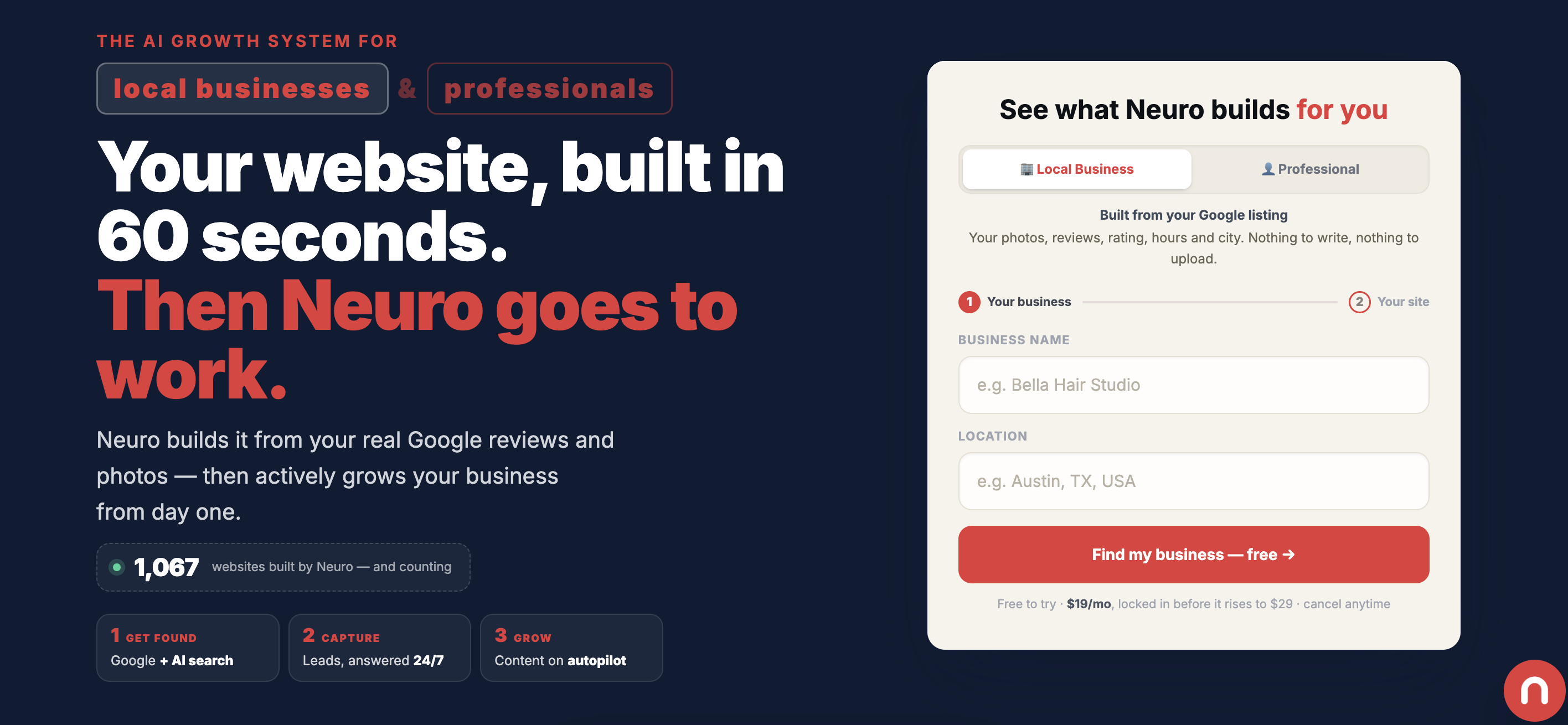
SiteNeuro Essential is the simplest option.
It is designed for a small business or independent professional that primarily needs a professional website without turning the project into a major web-development exercise.
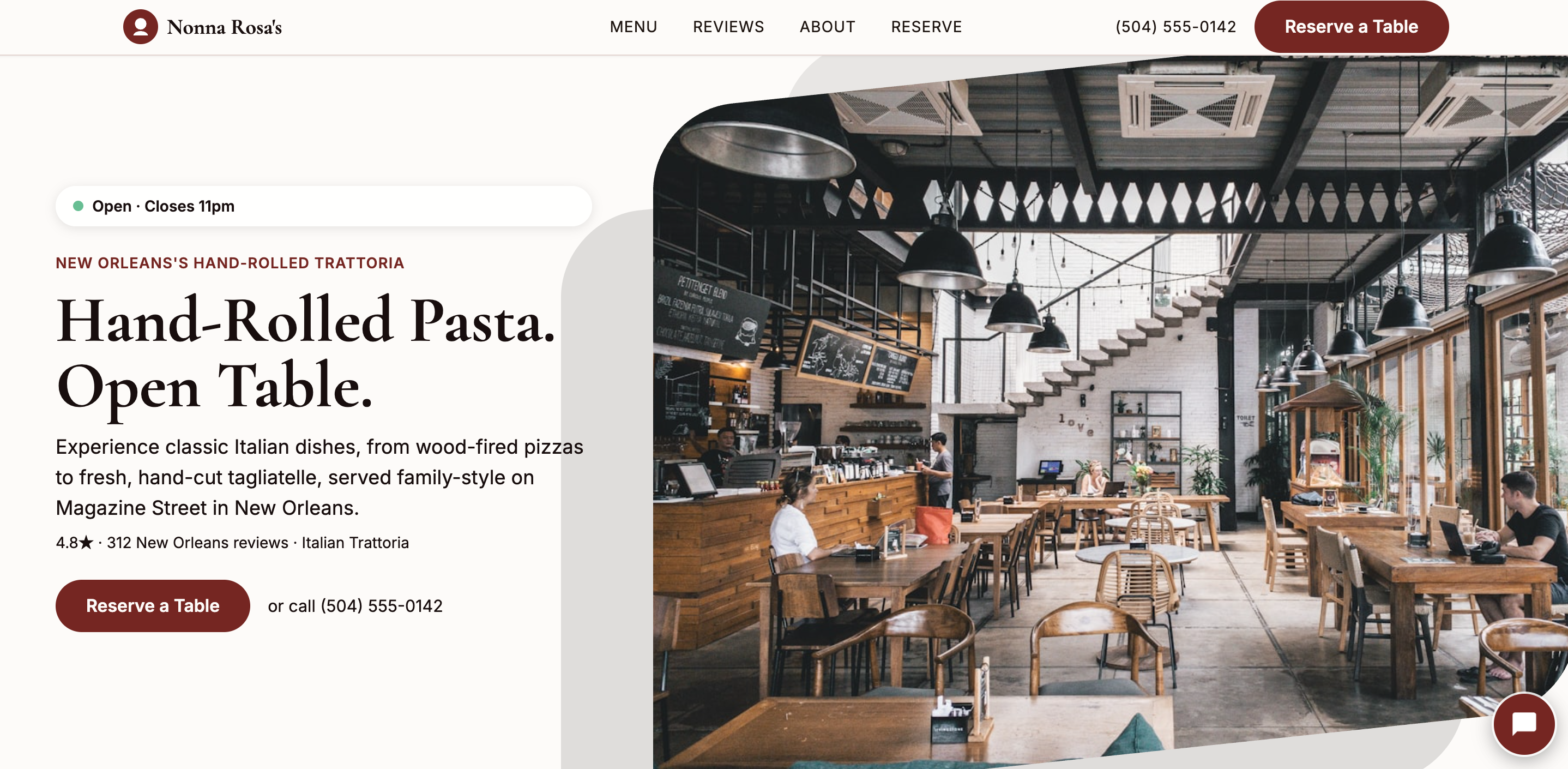
The current Essential plan is $39/year and includes hosting, SSL, CDN, custom-domain support, editing and a Google + AI search foundation. The site can be generated from a Google listing or LinkedIn profile in about a minute.
That's a very different proposition from hiring a designer, developer and copywriter to build a custom website.
But it is also intentionally narrower.
Essential gives you the website.
The higher SiteNeuro plans add Neuro itself as an ongoing worker.
---
Here is the current SiteNeuro ladder:
| Option | Best for | Website | Search | Neuro assistant | Content & marketing | Knowledge base |
|---|---|---|---|---|---|---|
| Essential — $39/year | Website only | ✓ | ✓ | — | — | — |
| Foundations — $19/mo* | Website + basic growth | ✓ | ✓ | ✓ | ✓ | Basic |
| Neural — $59/mo* | Growing businesses | ✓ | ✓ | ✓ | ✓✓ | Expanded |
| Apex — $119/mo* | Businesses wanting the full system | ✓ | ✓ | ✓ | ✓✓✓ | Largest |
| Apex Concierge | Businesses wanting hands-on setup | ✓ | ✓ | ✓ | ✓✓✓ | Apex-level |
*Current founding pricing; standard prices are $29, $79 and $149/month respectively.
The important distinction isn't simply the price.
It's who is doing the work.
---
Essential: “I just need a professional website.”
Essential is the foundation.
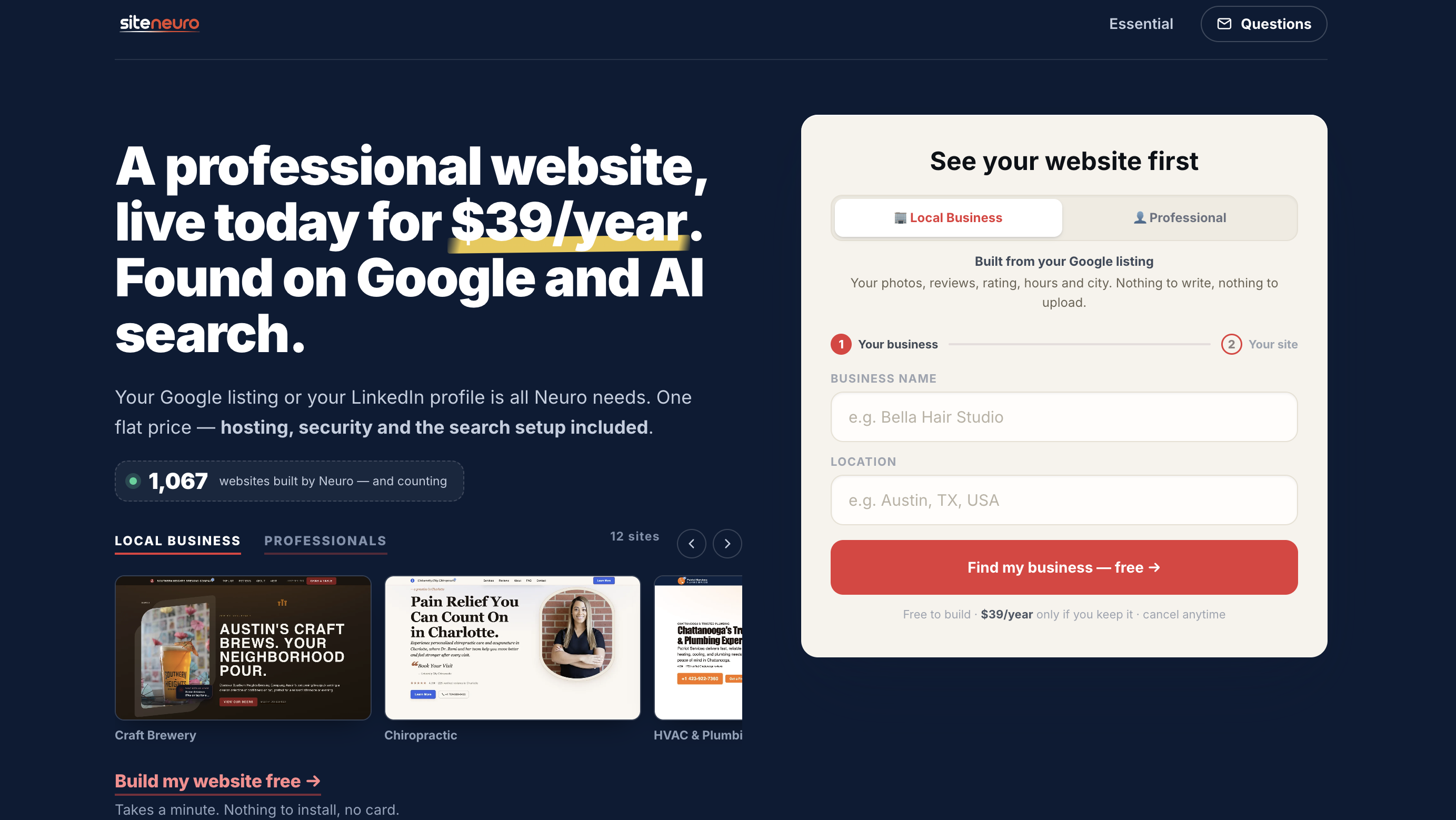
You get:
AI-generated website Professional niche-specific design Business information from Google or LinkedIn Hosting SSL CDN Custom domain connection Basic editing * Google + AI search setup
It's a straightforward choice for someone who wants the website itself.
---
Foundations: “I want Neuro to start working.”
Foundations adds the first layer of ongoing growth.
The current plan includes the website, Google Local SEO and AI search, monthly credits, a 24/7 Neuro conversation system and social posts.
Instead of:
Build website → figure everything else out yourself
the model becomes:
Build website → let Neuro keep working.
---
Neural: “I need more content and more context.”
Neural increases the available credits and conversations and adds document uploads for training Neuro with business-specific information.
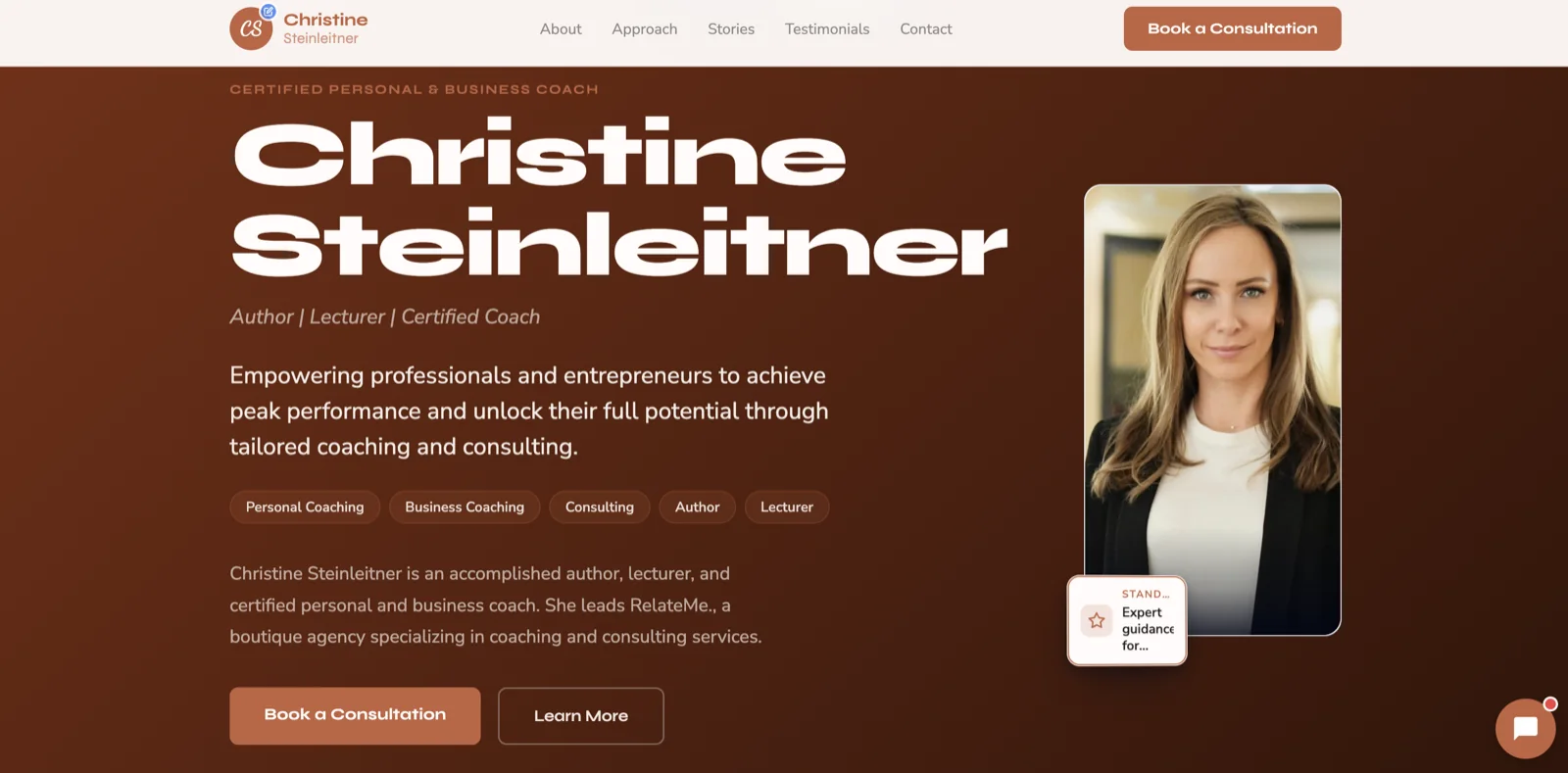
Curious what yours would look like?
Local business or professional — Neuro builds your site from your own data in about 60 seconds.
Build my demo in 60 seconds →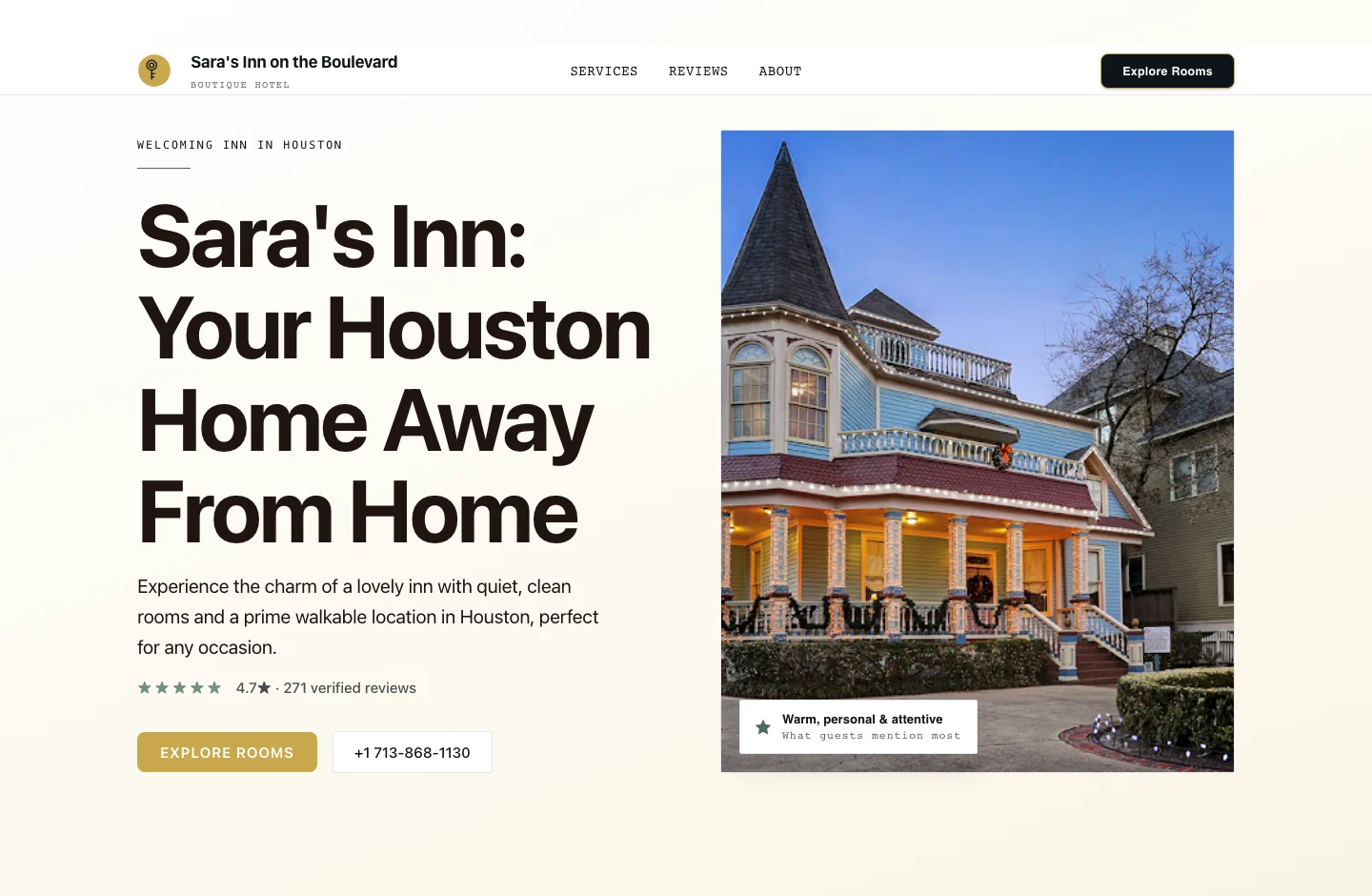

It also expands content capabilities, including blog posts, social posts, review replies and multilingual support.
This starts to make sense for businesses where content and customer questions are a meaningful part of growth.
---
Apex: “I want the whole growth system.”
Apex expands the system further with the largest knowledge base, more monthly credits, up to 3,000 Neuro conversations and 60 social posts per month at the current founding level.
The idea is simple:
You decide what matters. Neuro does more of the execution.
That can include content, website changes, SEO-related work, customer conversations and lead capture.
Explore the SiteNeuro options that Neuro goes to work 24/7
---
Apex Concierge: “I want help getting everything set up.”
For businesses choosing Apex but wanting a more hands-on onboarding experience, SiteNeuro also offers Apex Concierge, with specialist assistance in getting the system set up.
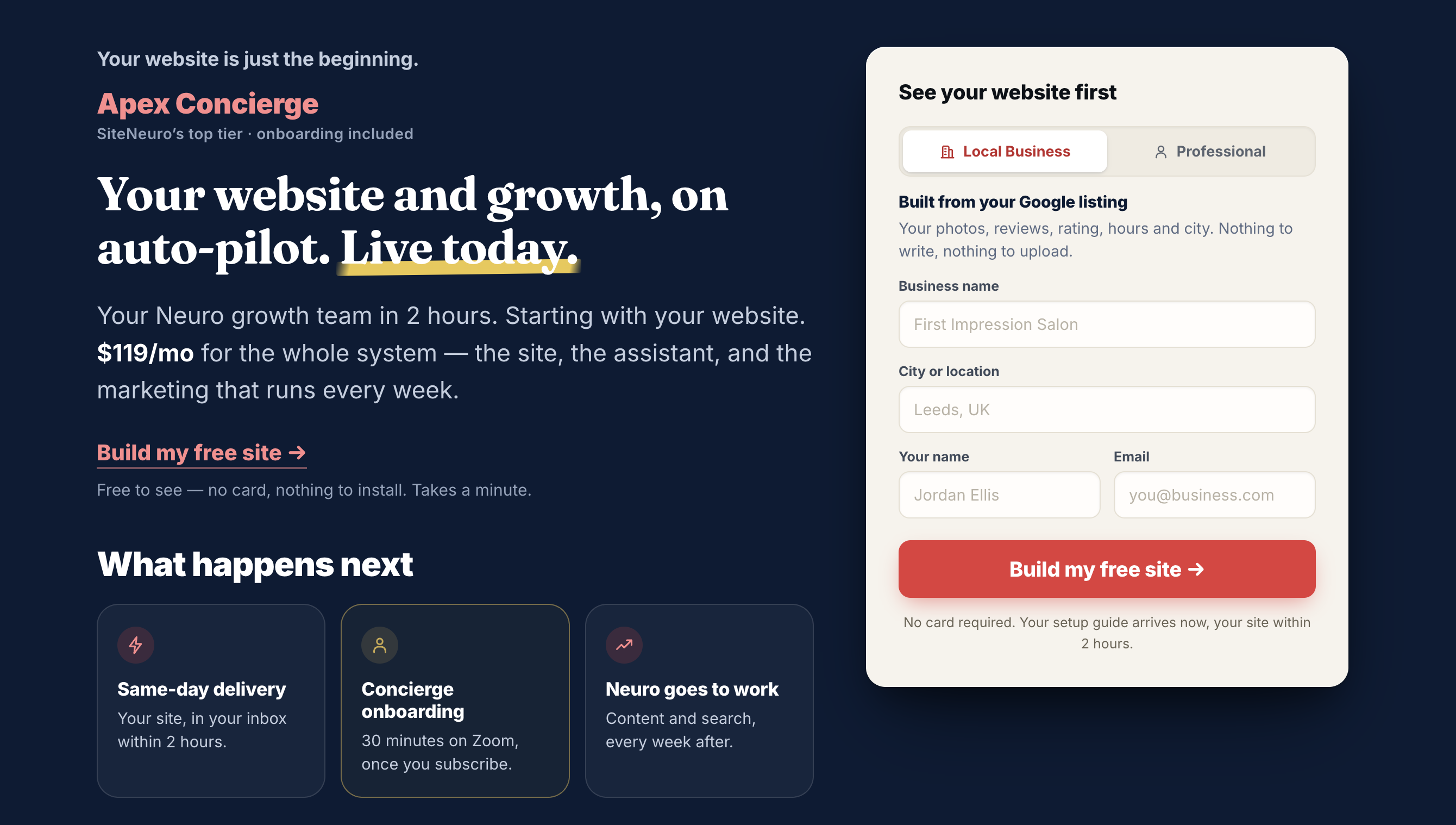
That addresses a different problem.
Sometimes the obstacle isn't the software.
It's getting everything configured properly in the first place.
Explore SiteNeuro Apex Concierge
---
There isn't one universal answer.
If you simply need a credible online presence, a professional small business website may be enough.
If you want your website to answer customers, capture leads and stay active, an ongoing AI growth platform starts to make more sense.
And if you want that system configured with more hands-on help, the Concierge route addresses the setup side.
The important thing is not to buy more technology than your business needs.
It's to identify the job your website needs to do.
---
The old model was straightforward:
Design website → publish → wait.
The newer model is more dynamic:
Build → learn → update → publish → answer → attract → improve.
That's where AI changes the economics.
The website can still be the digital front door.
But behind that door, an AI system can potentially help with the work that follows:
SEO. Content. Customer questions. Lead capture. Reviews. Updates. Marketing.
That is the larger idea behind SiteNeuro.
The website gets you online.
Neuro goes to work after that.
Build your free SiteNeuro demo →
Frequently asked questions
Will my website still work if I don't update it after launch?
How much does a small business website actually cost?
What if I don't want to hire a designer and developer?
How can my website help AI search systems understand my business?
Do I need blog posts and ongoing content, or is a basic website enough?
What's the difference between Essential and the higher-tier plans?
See what Neuro would build for you
Build your demo from your own data in about 60 seconds — then watch your AI team take it live and grow it.
Build my demo in 60 seconds → Explore the showcase