Build With AI
How to Build an AI App Without Coding: A Non-Technical Founder's Method
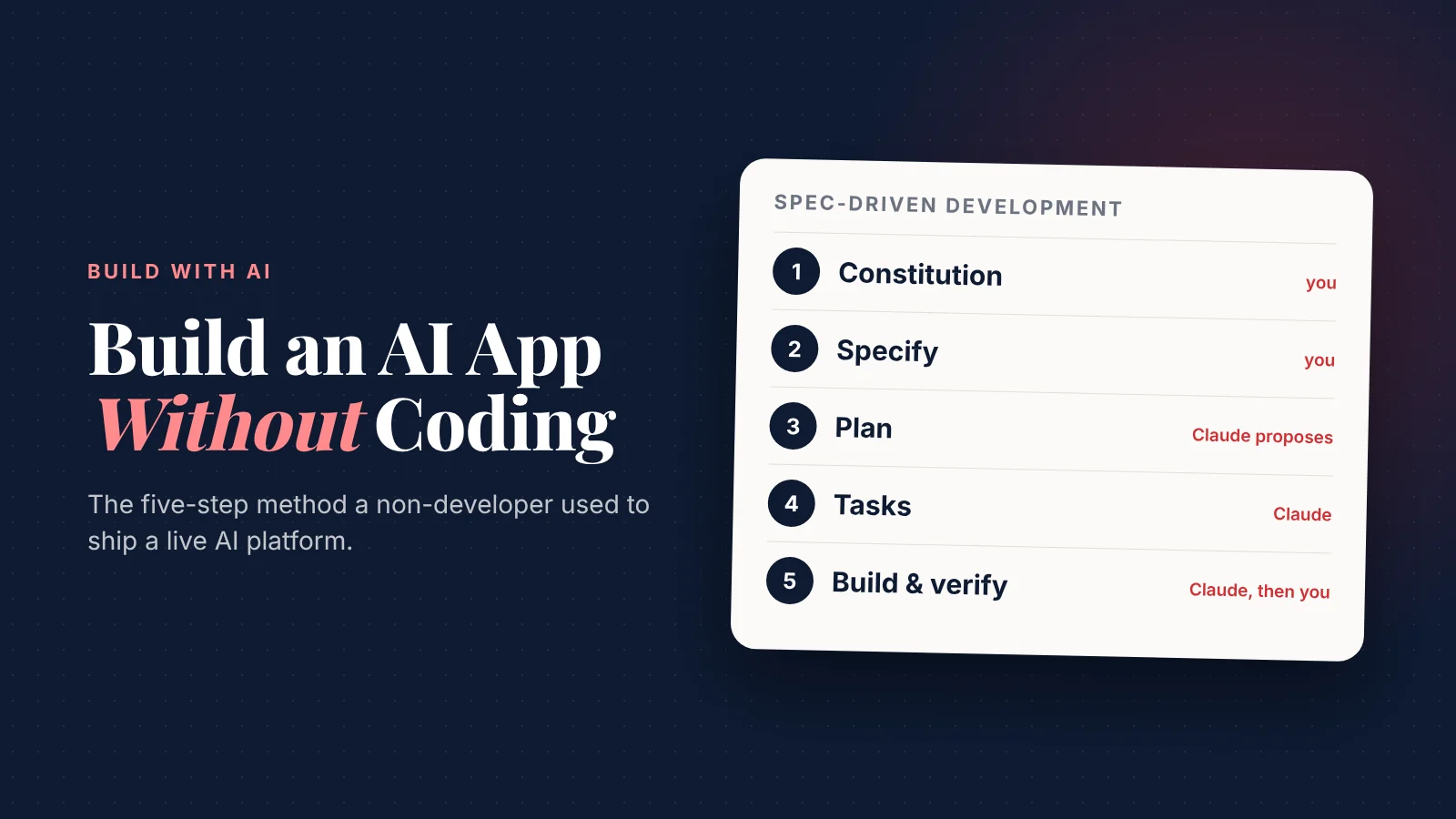
Can you build an AI app without coding? Yes. You write down what to build, in plain English. Claude, Anthropic's AI, writes the code from it. And you check every step like a customer would.
That's the whole method in three lines.
I know it works because I'm not a developer.
I'm a mechanical and industrial engineer with an MBA. Ten years as a designer, writer and business development consultant. I had never shipped software.
Then, in about six months and 1,000 hours, I built SiteNeuro, an AI platform that has built over 1,000 websites.
No technical co-founder. No engineering team.
Here's the method, so you don't have to learn it the hard way.
Why do most no-code AI attempts get stuck?
Most people start the same way.
They open a chat with an AI. They describe an app. The AI writes it. It works.
It feels like magic. For about a week.
Then the project grows, and things start to slip:
- The AI forgets what you decided last week.
- Every fix quietly breaks something else.
- You explain the same thing again and again, and get a slightly different answer each time.
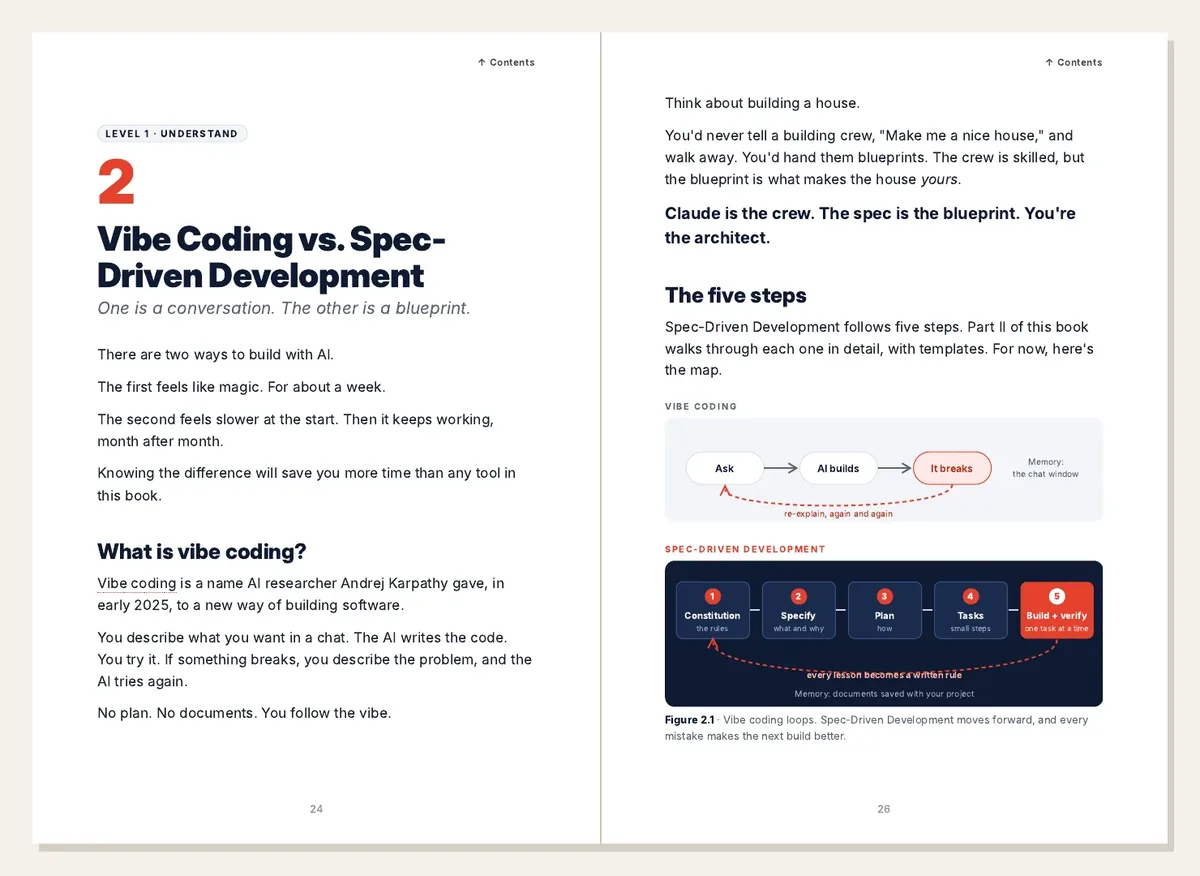
This way of building has a name: vibe coding. AI researcher Andrej Karpathy coined it in early 2025. You chat, the AI codes, you follow the vibe.
I lived it. In my first months, the AI created bugs and then struggled to fix them. Every new feature felt like pulling a thread from a sweater.
Here's the thing.
The problem wasn't the AI. The problem was that nothing was written down.
What do you need to build an AI app without coding?
Less than you think.
You need:
- An idea for something people would pay for or depend on.
- Claude Code, Anthropic's AI coding tool. It reads your project, writes and tests code, and works from your desktop, browser or phone. It needs a Claude Pro plan or higher.
- A free GitHub account, so every change is saved and can be undone.
- A few focused hours a week.
You don't need:
- A computer science degree.
- A technical co-founder.
- To learn a programming language.
But there's one thing you can't skip.
A method.
What is Spec-Driven Development?
Spec-Driven Development flips the order of vibe coding.
Before anything is built, you write down what you want, in plain language. That document is called a spec, short for specification.
The AI builds from the spec. When something needs to change, you change the spec first. Then the AI updates the build to match.
Think about building a house.
You'd never tell a building crew, "Make me a nice house," and walk away. You'd hand them blueprints.
Claude is the crew. The spec is the blueprint. You're the architect.
| Vibe coding | Spec-Driven Development | |
|---|---|---|
| Starts with | A chat message | A written spec |
| Memory | The chat window | Documents saved with your project |
| When it breaks | You explain it again | You fix the spec, then the build |
| Speed | Fast on day one | Fast on day one hundred |
| Best for | Experiments, one-page tools | Real products, paying customers |
| Your role | Asking | Architect |
So which one should you use?
Both, at different moments. Vibe code to see if an idea is even possible in an afternoon. Switch to specs the moment someone will pay for it or depend on it.
The 5 steps to build an AI app without coding
Spec-Driven Development in five steps
You write the what. Claude builds the how. You check every step.
Constitution
Your rules that never bend.
YouSpecify
What you're building and why. Never how.
YouPlan
How it will be built. You make the calls.
Claude proposesTasks
Small steps you can check in minutes.
ClaudeBuild & verify
Claude builds and tests. You check it like a customer.
Claude, then you
Something broke? Don't just fix it. Write it down as a rule in step 1, so the same mistake can't come back.
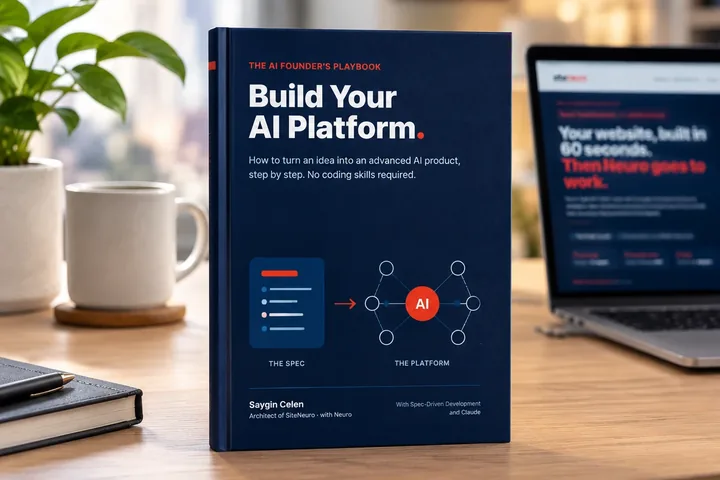
The book
The whole method, step by step, in one book.
Build Your AI Platform takes you from an idea to a live product with a buy button. Chapter 1 is free.
- 29 chapters, five levels, step by step
- Three complete builds, start to finish
- Templates, checklists and a prompt kit
- Chapter 1 is free to read, in full
Spec-Driven Development has five steps. Each one is short.
1. Constitution: your non-negotiables
The rules that never bend. Written once, read every time.
For example: "Every page must load fast on a phone." Or: "Never store a customer's card details."
2. Specify: what you're building and why
Describe what your customer does and gets. Never how it's built. That comes later.
3. Plan: how it will be built
Claude proposes the how: which tools, what data, which screens.
You make the calls. You don't need to know the answer. You need to ask "why?" until the choice makes sense to you.
4. Tasks: small steps you can check
The plan, cut into small steps. Each one small enough to check in minutes.
Big plans fail. Small steps ship.
5. Build and verify
Claude builds one task at a time and tests it. Then you try it yourself, like a customer would, before moving on.
Trust, but verify. Every single time.
And here's the part most people miss.
When something goes wrong, you don't just fix it. You write it down as a rule. The AI reads that rule every time it builds, so the same mistake doesn't come back.
That's how the quality of your product goes up every week instead of down.
A worked example: a spec in five sentences
Say your idea is a language tutor that teaches through the things you love: football, cooking, music.
Your first spec is five sentences:
- Who is it for? Adults learning Spanish who get bored with textbook lessons.
- What problem does it solve? Lessons feel irrelevant, so learners quit.
- What's the first thing they do? Pick three interests, then get a five-minute lesson built around them.
- What does success look like? They come back the next day without being reminded.
- What must never happen? Wrong grammar presented as correct.
That's it. Rough, and that's fine.
Claude can now propose a plan from those five sentences. And when you change your mind, you change the spec, not the chat.
(The book builds an app like this, a language tutor built around your interests, start to finish, all the way to a paid subscription.)
The prompt that keeps every build on track
If you only take one thing from this article, take this prompt.
I use it on every task, idea and bug:
"[Describe the task.] What is your understanding, concisely, in bullets? What is your implementation plan? After proposing the plan, stop and ask for my approval."
Three things happen:
- Misunderstandings show up before any code exists.
- You make the decisions. Claude does the work.
- Nothing ships that you didn't approve.
It looks too simple to matter. It saved me more hours than any tool.
How long does it take to build an AI app without coding?
It depends on what "app" means.
- A first working version: weeks, if you keep the first version small.
- A real platform with paying customers: for me, about six months and 1,000 hours, while learning everything for the first time.
For proof that this isn't a demo trick, here's SiteNeuro's own history from February to October 2026: 3,215 commits and 1,156 changes merged, over 175 working days. Every one built by Claude, and reviewed by me.
One person can now build what used to take a team of ten senior engineers, marketers and designers.
Not because the AI is magic.
Because the method turns you from someone asking an AI for things into someone leading it.
Where to start today
You don't need to finish anything today. Just start in the right order:
- Write your five-sentence spec (above).
- Write three rules for your constitution: what must always be true.
- Open Claude and use the plan-first prompt on the smallest useful piece.
- Check the result like a customer. Write down anything that went wrong as a rule.
Then do it again tomorrow.
Want the story behind this method, and everything it covers? I wrote about why I wrote Build Your AI Platform and what's inside.
Straight answers
Can I build an AI app without coding?
Do I need a technical co-founder to build an AI product?
What is the difference between vibe coding and Spec-Driven Development?
What is Claude Code?
How long does it take to build an AI app without coding?
Build your AI platform
The whole method, step by step, by a founder who is not a developer. Read Chapter 1 free first.
The Book $29 $19
244 pages. From your first idea to paying customers.
- 29 chapters in five levels
- Three complete builds
- A 30-day build challenge
- Templates, checklists, prompts, glossary
Book + Builder Kit $49 $39
The book, plus your first project set up for you.
- Everything in the book
- Starter project, ready for Claude Code
- 4 Claude skills and 6 guides
- Free updates
Founding price, for a limited time.