Local Market Snapshot
The Best Website for Law Firms in Mesa, AZ — What We Found
What does the best website for law firms in Mesa, AZ actually look like? We pulled up 19 real law firm websites serving the Mesa market and scored each one on a 0-100 website-quality scale — content depth, mobile-friendliness, conversion paths, trust signals, technical SEO. Here's what we found.
The short version: Mesa's law firm websites are decent.
Not great. Decent.
The average score came out to 64 out of 100.
That's actually the strongest average of every local market we've studied so far — which says something good about the firms here. But 64 still isn't a passing grade in a field where trust is the entire sale.
Let's break down what that number means, where the real gaps are, and what a stronger site looks like.
What a 64/100 score actually means
A 0-100 website score isn't a beauty contest.
It's a proxy for one question: does this site do the job of turning a visitor into a client?
A score in the 60s usually means the basics are there. The site loads. It has a phone number. It probably lists what the firm handles.
What it usually doesn't have is depth — the layer of detail and trust-building that actually gets a stressed, high-stakes visitor to pick up the phone instead of clicking back to Google.
Mesa's firms are ahead of the other markets we looked at. That's real, and it's worth saying plainly instead of dressing up a good number as a bad one.
But "ahead of average" and "actually converting every visitor who's ready to hire" are two different things. A 64 still leaves real room — and in legal services, the gap between "fine" and "trustworthy" is where clients are won or lost.
What's dragging the average down
Across the 19 sites, a few patterns showed up again and again. None of this is about any one firm — it's what kept repeating across the sample.
Your growth partner
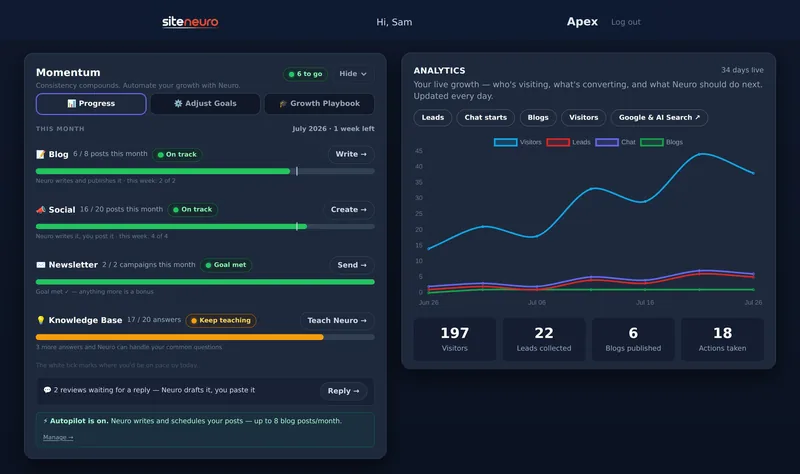
Neuro built Gergen Hale Campbell (GHC Law Firm)'s website. Then kept it working.
- Built from your Google or LinkedIn
- Answers visitors, captures leads
- Drafts blog, social and newsletter
- Nothing goes out until you approve it
Missing review widgets or client testimonials. Many of the sites we looked at didn't surface reviews or testimonials anywhere on the page. For most local businesses, that's a missed opportunity. For a law firm, it's a bigger one — someone choosing legal representation is making a high-stakes, high-trust decision, and social proof is one of the fastest ways to earn that trust before a call ever happens.
Missing Open Graph and social-share meta tags. A recurring pattern across these firms was no Open Graph setup — meaning when a link to the site gets shared or texted, it shows up blank or broken instead of a clean preview with the firm's name and photo. Small technical detail, real credibility cost.
Dated visual design. Several sites still carry a visual style that reads as several years old. Fair or not, a dated site quietly signals a dated practice to a first-time visitor — the opposite of what a firm wants to project when someone is vetting who to trust with their case.
Weak or unclear calls-to-action. A recurring theme: phone-only contact, with no "free consultation" framing and no sense of urgency. A phone number alone asks a lot of a nervous first-time visitor. It doesn't tell them what happens if they call, what it costs, or why now.
Missing schema markup and local SEO structuring. Several of the sites had no structured data telling Google (or an AI assistant) what the firm actually practices and where. Without it, a firm can be excellent and still be invisible to the exact searches — "divorce lawyer near me," "DUI attorney in Mesa" — that would otherwise send them a client. That's the same root problem behind why customers can't find you online: the business is real, but nothing online says so clearly enough to get matched to the search.
Turning that into a client-getting site
Turn each gap around, and you get a checklist:
- Practice areas stated plainly near the top — not buried in a dropdown menu
- Real attorney bios — bar admissions, law school, years practicing, not a stock photo and a title
- Testimonials or reviews, where your state bar allows them — real social proof, not just adjectives about the firm
- A clear, urgent consultation path — "Schedule a Free Consultation," visible on every page, not just a phone number and a hope
- Schema markup and basic local SEO — so search engines and AI assistants can actually match the firm to the searches people run
- Open Graph tags — so a shared link looks credible, not broken
- A current, professional visual design — the site should look like the practice it represents
None of this is exotic. It's the handful of trust signals that separate "the firm exists" from "I trust this firm enough to call."
For the full playbook on winning more clients online — including how to handle reviews the right way — see how law firms get more clients.
What this looks like built out
It's easier to see this than describe it.
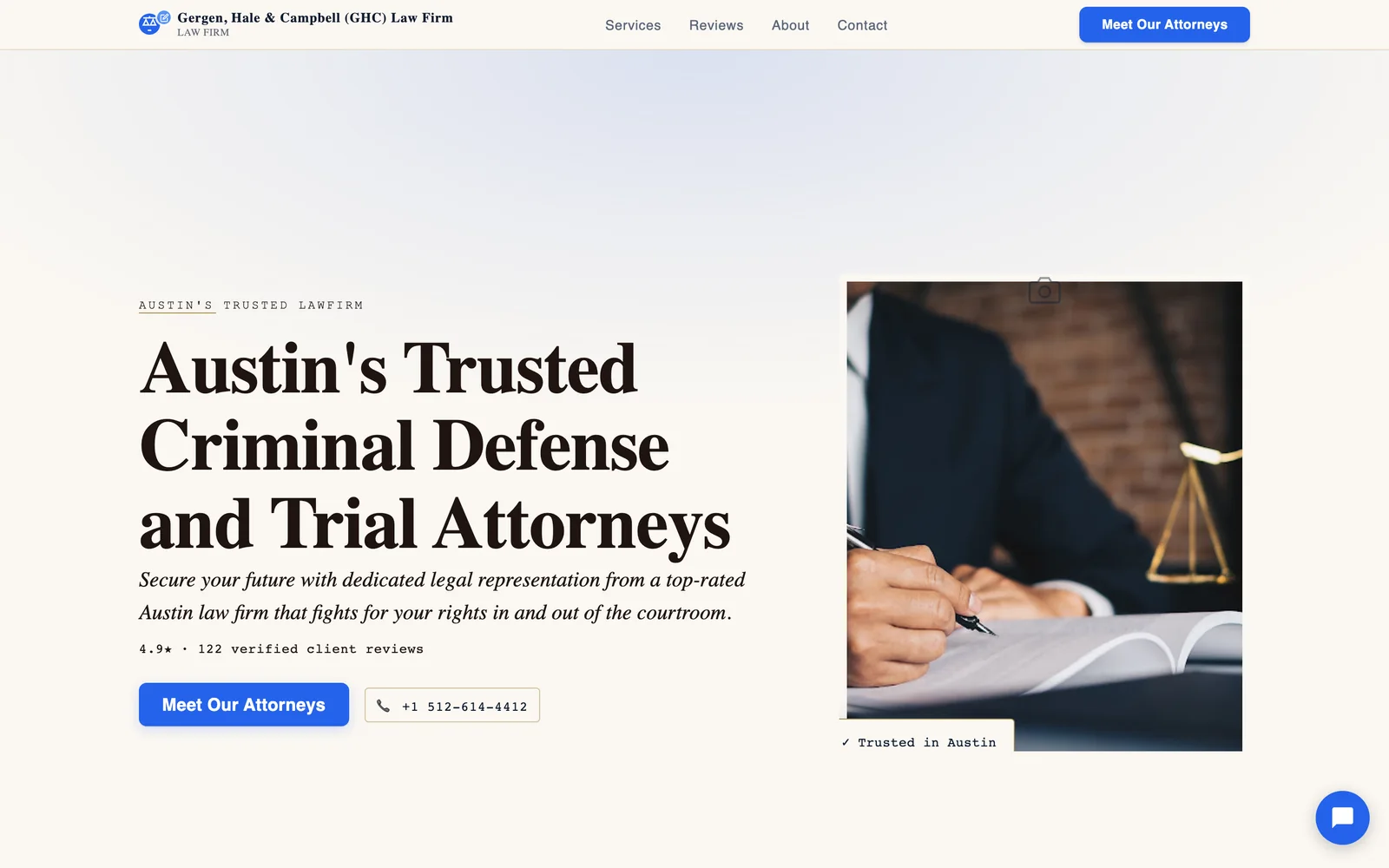
Gergen Hale Campbell (GHC Law Firm) is a real, live Neuro-built law firm site — worth being upfront that it's not a Mesa business. We're including it here simply as an example of what a well-built law firm site looks like in practice, not as a local comparison.
The practice areas sit near the top, stated plainly. Attorney bios carry real credentials instead of a stock headshot. And a schedule-a-consultation path is visible without digging — the same checklist above, just built out.
Straight answers
Is 64/100 a good website score for a law firm?
Why does review content matter so much for a law firm's website?
What is schema markup, and why does a law firm need it?
Can a Mesa law firm use client testimonials on its website?
What's the single fastest fix for a law firm site stuck around a 60?
Is Neuro a good option for a law firm building a new site?
Ready to put this to work?
Pick how much help you want. Both start with a free look at your site.
Essential $39/year
Just the website, done properly.
- Built from your Google or LinkedIn
- Set up for Google and AI search
- Hosting and security included
- Unlimited edits, no extra cost
Apex Concierge $119/mo
Your website, plus a growth team every week.
- Your site in your inbox within 2 hours
- 30-minute setup call with a specialist
- Answers visitors, captures leads
- Drafts blog, social and newsletter
See a real law firm example: Gergen Hale Campbell (GHC Law Firm)