Get More Customers
How Law Firms Get More Clients Online
How do law firms get more clients online? By ranking for the exact searches people run when they need a lawyer — "divorce lawyer in [city]," "personal injury attorney near me" — and by giving that visitor, once they land, the trust signals they need to actually pick up the phone.
That's it. That's the whole game.
Most firms get half of it right and wonder why the phone doesn't ring.
Let's fix both halves.
The searches that actually bring you clients
Nobody searches "best law firm."
They search for a problem, plus a place.
- "Divorce lawyer in [city]"
- "Personal injury attorney near me"
- "DUI lawyer [city]"
- "Business attorney for small business"
- "Estate planning lawyer near me"
Each one names the practice area and the location. That's not an accident — it's how someone in a legal situation actually thinks. They don't want a generalist. They want the person who handles this specific problem, close enough to meet.
So your site has to say, in plain words, near the top:
- What you practice (family law, personal injury, criminal defense, business law, estate planning — whatever it actually is)
- Where you practice (city, county, the courts you appear in)
If a search engine — or an AI assistant someone asks "who's a good divorce lawyer in [city]" — can't tell what you do and where, it can't send you the client. This is the same gap that causes why customers can't find you online for almost any local business: you exist, but nothing online says so clearly enough to get matched to the search.
Why a LinkedIn profile or bar directory listing isn't enough
You're probably already listed somewhere.
A bar association directory. Avvo. LinkedIn. Maybe all three.
None of them are enough on their own, and here's why.
A directory listing answers "does this lawyer exist." It doesn't answer the question a prospective client is actually sitting with: "Can I trust this person with the most stressful thing happening in my life right now?"
Legal decisions are high-stakes. A custody fight. A criminal charge. An injury that upended someone's income. Nobody makes that call lightly, and nobody hires a name off a list without looking harder first.
So they go looking for:
- What you've actually handled. Case types, not just a practice-area label.
- Who you are. Credentials, bar admission, years practicing, where you went to school.
- What other clients say. Real signals of how you treat people, not just whether you win.
- How to reach you. A phone number they can call right now, not a contact form that vanishes into a queue.
A directory profile gives you a name and a phone number in a sea of other names and phone numbers. A website you control can answer all four of those questions before the visitor ever has to ask.
The trust signals that actually make someone call
This is the part most solo and small firm sites get wrong — not because the lawyer doesn't have the substance, but because the site doesn't surface it.
Curious what a law firm website like this looks like for you?
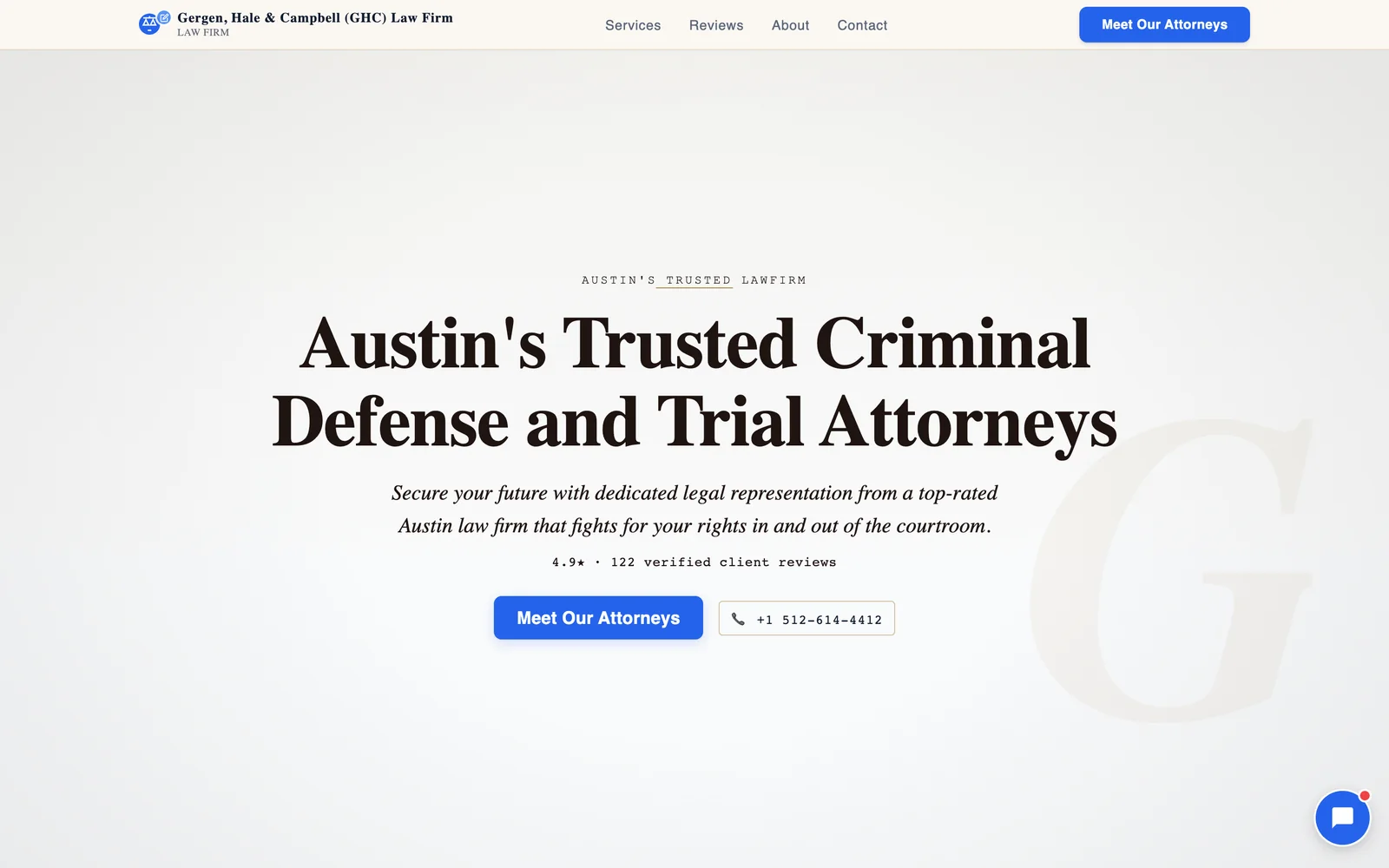
Neuro built Gergen Hale Campbell (GHC Law Firm)'s site from their own Google data — yours can be next, in about 60 seconds.
Build my demo in 60 seconds →

Put your practice areas up front, not buried in a menu. The visitor should know within seconds whether you handle their kind of problem. If you do family law and personal injury, say both, clearly, above the fold — don't make someone hunt through a "Services" dropdown to find out.
Give every attorney a real bio. Not a stock headshot and a one-line title. Include bar admissions, law school, years of practice, and the kinds of matters they actually handle. A prospective client researching "is this person qualified for my case" wants specifics, not a title.
Show real case-type experience. You likely can't (and shouldn't) publish case details or client names without consent — and many bar rules restrict how you describe outcomes. But you can honestly describe the categories of matters you handle regularly: contested divorces, DUI defense, slip-and-fall claims, small business formation. That's enough to signal genuine experience without crossing an ethics line.
Add testimonials where your bar rules allow it. Client testimonials are one of the strongest trust signals on the internet — people believe other people, not marketing copy. Check your jurisdiction's advertising rules first (some states restrict testimonials or require disclaimers), and only use ones you have clear permission to publish. Where it's allowed, even two or three short, specific quotes do more work than a page of adjectives about your firm.
Make "schedule a consultation" the obvious next step. Don't make a stressed visitor dig for how to reach you. A clear, single path — "Schedule a Consultation" — visible on every page, tells them exactly what to do next.
Keep your phone number visible everywhere. This one matters more for law firms than almost any other local business. A lot of legal inquiries are urgent, personal, and still convert by phone, not a web form. Someone who just got served papers, or was just in an accident, wants to talk to a person now. Put your number in the header, not just a footer, and make it tap-to-call on mobile.
A prospective client isn't shopping for a lawyer the way they shop for a plumber. They're deciding who to trust with something that matters. Your website's job is to earn that in under a minute.
Responding to reviews — carefully, but consistently
Online reviews matter for law firms the same way they matter for any local business — arguably more, because a visitor reading them is trying to answer "will this person actually help me, and will they treat me well while doing it."
The catch: you have real, specific confidentiality obligations a restaurant doesn't.
Here's how to handle it well:
- Thank positive reviews briefly and generally. A simple "Thank you for trusting our firm with your case" is enough. Don't confirm details of the matter, even to agree with a happy client's public description of it.
- Never confirm you represented someone in a negative review, even to correct them. Confirming the relationship at all can be a confidentiality problem, regardless of what the reviewer already said publicly.
- Respond with a general, professional statement. Something like: "We take all client feedback seriously. Because of our ethical obligations, we can't discuss any specific matter publicly. Please contact our office directly so we can address your concerns." That shows every future reader you take feedback seriously — without confirming or denying anything.
- Never argue in public. A calm, consistent, boilerplate response to a hard review often reads better to a future prospective client than silence does. Silence looks like you don't care. A canned, careful reply looks like you know the rules and follow them — which is itself a trust signal.
Consistency is the actual goal here — not winning the argument, just showing every future visitor that you respond like a professional every time.
What this looks like built out: GHC Law Firm
It's easier to see this than describe it.
Gergen Hale Campbell (GHC Law Firm) is a live demo site built from a real firm's actual practice areas and attorney profiles.
The practice areas are stated plainly near the top — no digging through a menu to figure out what the firm handles. Attorney bios carry real credentials instead of a stock photo and a title. And a schedule-a-consultation path sits right where a visitor would look for it, not buried three clicks deep.
None of that is a design trick. It's the same handful of trust signals above, just laid out so a stressed visitor doesn't have to work to find them.
You can see more examples across different practice types and industries in the showcase — including how firms in other professional fields, like how accountants get more clients and how real estate agents get more leads, solve the same trust-before-contact problem in their own way.
Curious how law firm sites are actually doing in a specific market? We scored a real sample: the best website for law firms in Mesa, AZ.
Frequently asked questions
Do I need a full website, or is a bar directory listing enough?
What should be on a law firm's homepage?
Can I use client testimonials on my law firm website?
Should I respond to negative reviews about my firm?
How important is the phone number, really, if I have a contact form?
Is Neuro a good option for a solo or small law firm's website?
See what Neuro would build for you
Build your demo from your own data in about 60 seconds — then watch your AI team take it live and grow it.
See a real law firm example: Gergen Hale Campbell (GHC Law Firm)
Build my demo in 60 seconds → Explore the showcaseWant Neuro running this for you every week? See Apex Concierge — from $119/mo →