Get More Customers
How Real Estate Agents Get More Listings and Leads Online
Want to know how real estate agents get more leads without buying more portal ads?
Stop competing only on Zillow and Realtor.com.
Get a personal website that makes a buyer, seller, or referral remember your name — not just your headshot in a grid of twelve other agents.
Here's how that actually works, and what to put on the site so it converts.
Why Zillow and Realtor.com aren't enough on their own
Your Zillow profile is real estate's most crowded room.
Every agent in your market has one. Same layout. Same photo size. Same "contact agent" button.
A buyer scrolling that page isn't choosing you — they're choosing whoever's face catches their eye first.
You paid to be in that room. You didn't pay to stand out in it.
That's the trap. Portal profiles get you visibility. They don't get you recognition.
And recognition is what turns a browser into a buyer who calls you specifically, instead of whichever agent's name happened to be attached to the listing.
A personal website is what makes someone choose you specifically
Here's the shift.
A portal profile answers one question: "Is this person a licensed agent?"
A personal website answers the question that actually matters: "Is this the right agent for me?"
That's a different job entirely.
Your own site can show:
- The neighborhoods you actually work, not a generic service radius.
- The kind of buyer or seller you specialize in — first-time buyers, luxury, relocation, investment.
- Your voice, your face, your track record — in your words, not a portal's template.
None of that fits in a Zillow card. All of it fits on a homepage.
This is the difference between being an agent and being the agent.
The trust signals that actually win a listing appointment
A home is the biggest purchase most people will ever make.
They're not hiring you off a coin flip. They're looking for reasons to trust you — or reasons to click away.
Here's what a website needs to earn that trust:
A real "about me" — not a bio template
Skip the stock paragraph every agent copies from their brokerage's website.
Say what area you actually know, how long you've worked it, and what kind of transactions you handle best.
Specific beats polished. "I've sold homes in this neighborhood for years and know which streets flood in spring" earns more trust than any generic tagline.
Active listings and past sales, front and center
A buyer or seller wants proof you close deals — not just that you're licensed to try.
Show your current listings. Show homes you've sold. Let the work speak.
Client testimonials in their own words
A five-star badge means little. A sentence from a real seller about how you handled a tricky negotiation means a lot.
Testimonials do the selling you don't have to.
One easy next step
Every page should make one thing obvious: how to reach you.
"Schedule a showing." "Get a free home valuation." "Call or text me directly."
Bury that behind a contact form on page three and you lose the lead to the next tab they open.
Why mobile speed decides who gets the call
Most home searches don't start at a desk. They start on a phone, in bed, on a lunch break, mid-scroll.
Curious what a real estate website like this looks like for you?
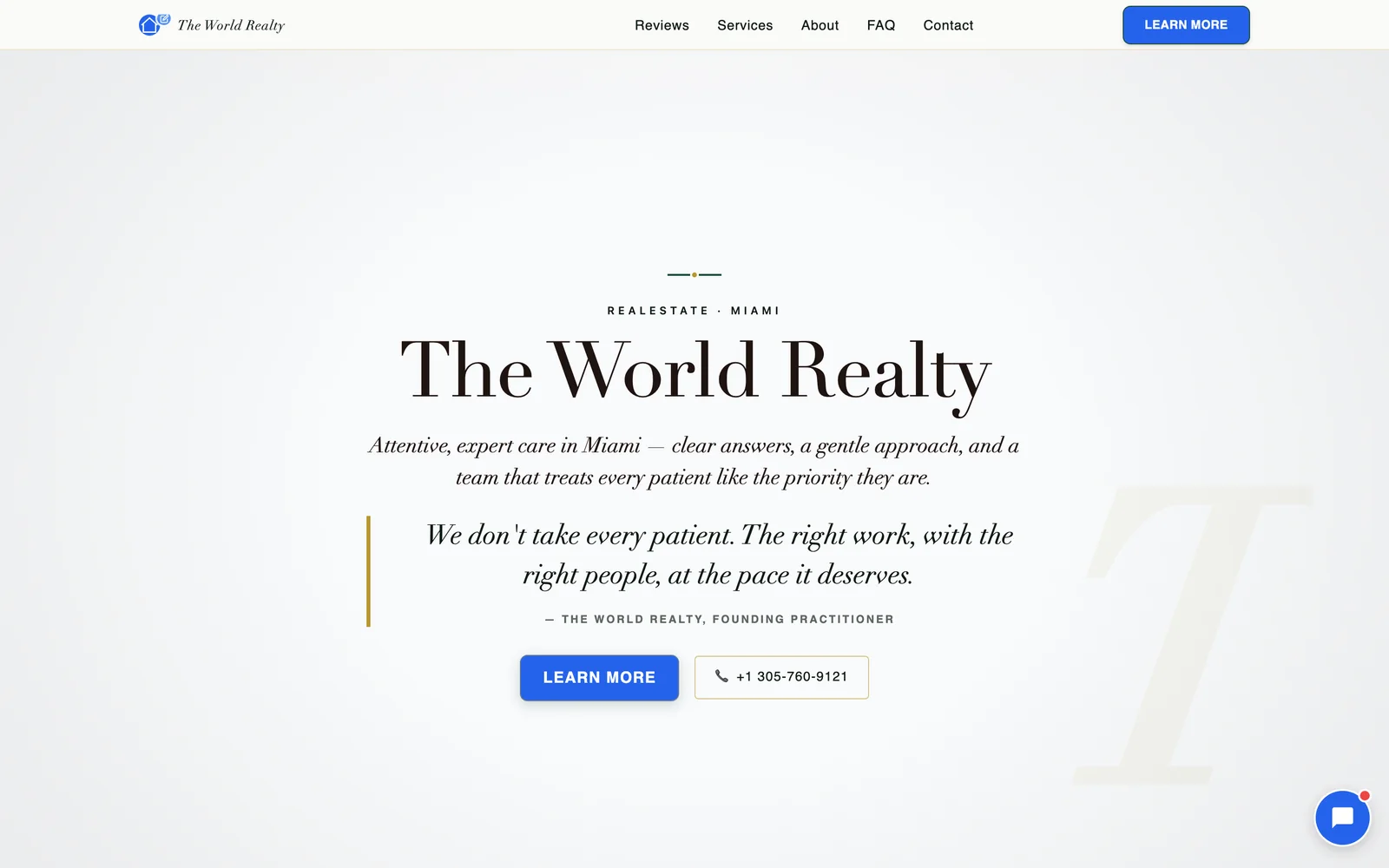
Neuro built The World Realty's site from their own Google data — yours can be next, in about 60 seconds.
Build my demo in 60 seconds →

If your site takes more than a couple of seconds to load on that phone, most people are already gone — back to search results, back to a competitor's site, back to the portal.
A slow site doesn't just look bad. It never gets seen at all.
This matters more for real estate than almost any other local business, because the decision is high-stakes and the browsing is casual — someone deciding whether to reach out is judging you in seconds, not minutes.
Fast, clean, mobile-first isn't a nice-to-have here. It's the whole game.
Ranking for "realtor near me" and hyper-local searches
Buyers and sellers don't search "real estate agent." They search their neighborhood.
"Realtor in [neighborhood]." "[City] home valuation." "[Suburb] listing agent."
A generic bio page can't rank for that. A site built around your actual service area — with your neighborhoods named in real sentences, not buried in a footer — can.
That's the same underlying problem covered in why customers can't find you online: if your site never mentions the specific place someone is searching from, it's invisible to that search no matter how good your work is.
This isn't unique to real estate, either. The same local-search logic is why restaurants lose customers to thin websites and why law firms live or die on how they show up for a specific city and practice area.
Hyper-local, specific, and real beats generic every time — in every one of these fields.
The referral pipeline your website is quietly protecting
Referrals are the best leads in real estate. They already trust you before they call.
But here's what actually happens before that call: they google your name first.
If what comes up is a thin agent-directory profile, or nothing at all, that warm referral cools off fast. The trust a friend just handed you gets undercut by a search result that makes you look unestablished.
If what comes up is a real website — your listings, your reviews, your area, a clear way to reach you — the referral gets confirmed, not questioned.
A personal website is what a referral checks before they dial. It's not optional infrastructure. It's the last step of the handoff.
What this looks like on a real agent site
Neuro built a live example worth studying: The World Realty.
It's built from the agent's actual listings, service area, and reviews — not stock photography or placeholder copy.
A schedule-a-showing path sits up front, not buried behind a menu. The neighborhoods the agent actually covers are named, not implied. The trust signals above — real listings, real testimonials, a clear next step — are all there, working together on one page.
You can browse more examples across other local businesses in the showcase to see the same principles applied in different niches.
The bottom line
Portal profiles get you into the room. A personal website gets you remembered, trusted, and called.
Build one around your real listings, your real area, and your real reviews — and every referral, every hyper-local search, and every curious buyer has a reason to choose you specifically.
Frequently asked questions
Do I still need a Zillow or Realtor.com profile if I have my own website?
What should be on a real estate agent's homepage?
How important are testimonials compared to reviews on Google or Zillow?
Does a personal website help with referrals?
How fast does a real estate website need to load?
Is a website worth it for a solo agent, or only for teams and brokerages?
See what Neuro would build for you
Build your demo from your own data in about 60 seconds — then watch your AI team take it live and grow it.
See a real real estate example: The World Realty
Build my demo in 60 seconds → Explore the showcaseWant Neuro running this for you every week? See Apex Concierge — from $119/mo →