Build With AI
Vibe Coding vs. Spec-Driven Development: Which One Actually Ships?
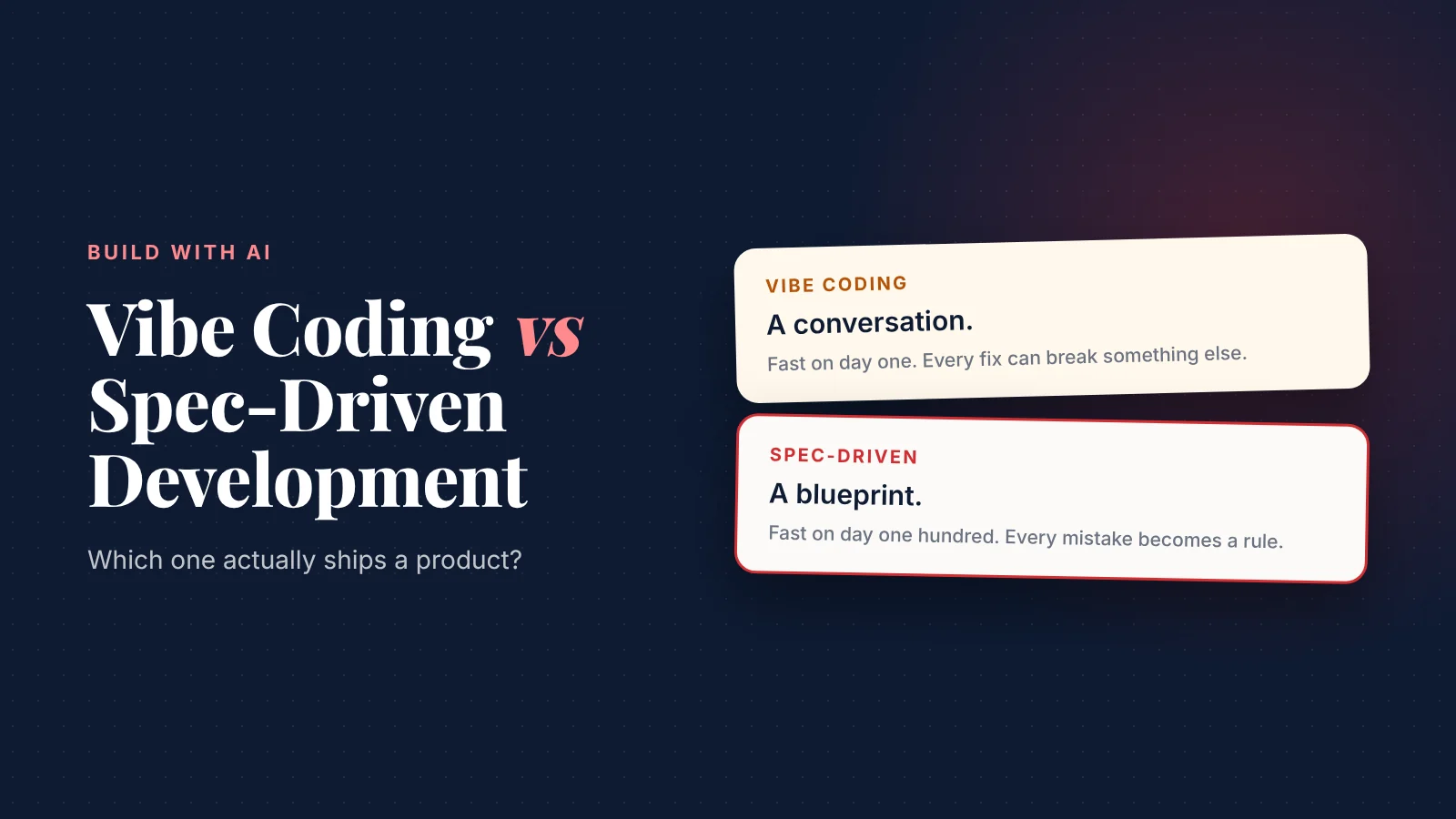
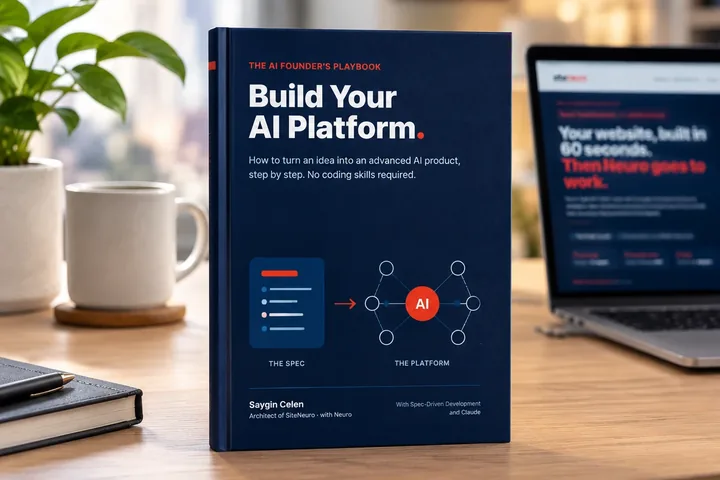
Vibe coding vs. Spec-Driven Development: what's the difference? Vibe coding builds software through a chat: you ask, the AI codes, you fix what breaks. Spec-Driven Development writes down what to build first, in plain English, and the AI builds from that document.
One is a conversation. The other is a blueprint.
Both use the same AI. Only one of them still works when your project gets big.
I learned this the expensive way. I'm not a developer, and I built SiteNeuro, a live AI platform, with Claude. My first months were vibe coding. The months that worked were spec-driven.
Here's the difference, and how to pick.
What is vibe coding?
Vibe coding is a name AI researcher Andrej Karpathy gave, in early 2025, to a new way of building software.
You describe what you want in a chat. The AI writes the code. You try it. If something breaks, you describe the problem, and the AI tries again.
No plan. No documents. You follow the vibe.
For small things, it's wonderful. A landing page. A calculator. A weekend experiment.
You can go from idea to working result in an afternoon.
Where does vibe coding break?
The trouble starts when your project grows.
- The AI doesn't remember what you decided last week. The chat is the only memory, and chats end.
- Each fix can quietly break something else. Nothing tells the AI what must stay true.
- You explain the same thing again and again, and get a slightly different answer every time.
I lived this. In my first months, the AI created bugs and then struggled to fix them. Every new feature felt like pulling one thread from a sweater.
Here's the thing.
The problem wasn't the AI. The problem was that nothing was written down.
What is Spec-Driven Development?
Spec-Driven Development flips the order.
Before anything is built, you write down what you want, in plain language. That document is called a spec, short for specification.
A spec says what a part of your product must do, for whom, and what must never happen. It's the single source of truth. The AI builds from it.
When something needs to change, you change the spec first. Then the AI updates the build to match.
It follows five steps:
- Constitution: the rules that never change.
- Specify: what you're building and why, from your customer's point of view.
- Plan: how it will be built. Claude proposes, you decide.
- Tasks: the plan, cut into small steps you can check.
- Build and verify: Claude builds one task at a time. You test it before moving on.
Claude is the crew. The spec is the blueprint. You're the architect.
Vibe coding vs. Spec-Driven Development, side by side
One loops. The other moves forward.
Why vibe-coded projects stall, and spec-driven ones keep shipping.
Vibe coding
Nothing is written down, so every fix starts from zero.
Spec-Driven Development
↺ Every mistake becomes a written rule the AI reads on every build.
Documents are the memory, so every build starts smarter.
Vibe code to explore. Write the spec the moment someone will pay for it or depend on it.
The book
Stop looping. Start shipping.
Build Your AI Platform teaches Spec-Driven Development step by step, for people who don't code. Chapter 1 is free.
- 29 chapters, five levels, step by step
- Three complete builds, start to finish
- Templates, checklists and a prompt kit
- Chapter 1 is free to read, in full
| Vibe coding | Spec-Driven Development | |
|---|---|---|
| Starts with | A chat message | A written spec |
| Memory | The chat window | Documents saved with your project |
| When it breaks | You explain it again | You fix the spec, then the build |
| Speed | Fast on day one | Fast on day one hundred |
| Best for | Experiments, one-page tools | Real products, paying customers |
| Your role | Asking | Architect |
The key row is speed.
Vibe coding is faster for the first hour. Spec-Driven Development is faster every week after that, because nothing has to be explained twice.
When should you use each one?
Both. At different moments.
- Vibe code to explore. Testing whether an idea is even possible? Chat your way to a rough version in an afternoon.
- Switch to specs the moment it becomes a product.
The simple rule I use:
If someone will pay for it or depend on it, write the spec.
And not every change needs the full method. A typo or a color change can go straight to the AI. A new feature, or anything that touches money, data or customers, gets a spec.
A quick test: if it needs a "done when" longer than one line, it needs a spec.
Do you need a special tool for Spec-Driven Development?
No. The method matters more than the tool.
You can follow it with nothing but a folder of documents and Claude. Or you can use a tool that sets it up for you.
The main options, as of October 2026 (these tools change fast, so check each one's own site):
- A plain folder: your own constitution, specs, plans and tasks, plus a project memory file. Best for learning the method and small products.
- Spec Kit: GitHub's free, open-source toolkit, released in September 2025. Templates and step-by-step commands inside your AI tool. Works with Claude Code. My recommendation for following the full method.
- Kiro: Amazon's code editor built around specs. One request produces requirements, design and tasks. Paid usage.
- OpenSpec: a lightweight, open-source approach that tracks how each change alters your specs. Good for adding features to a product that already exists.
- BMAD Method: an open-source method that runs a team of AI roles, from analyst to tester. For larger products that need more ceremony.
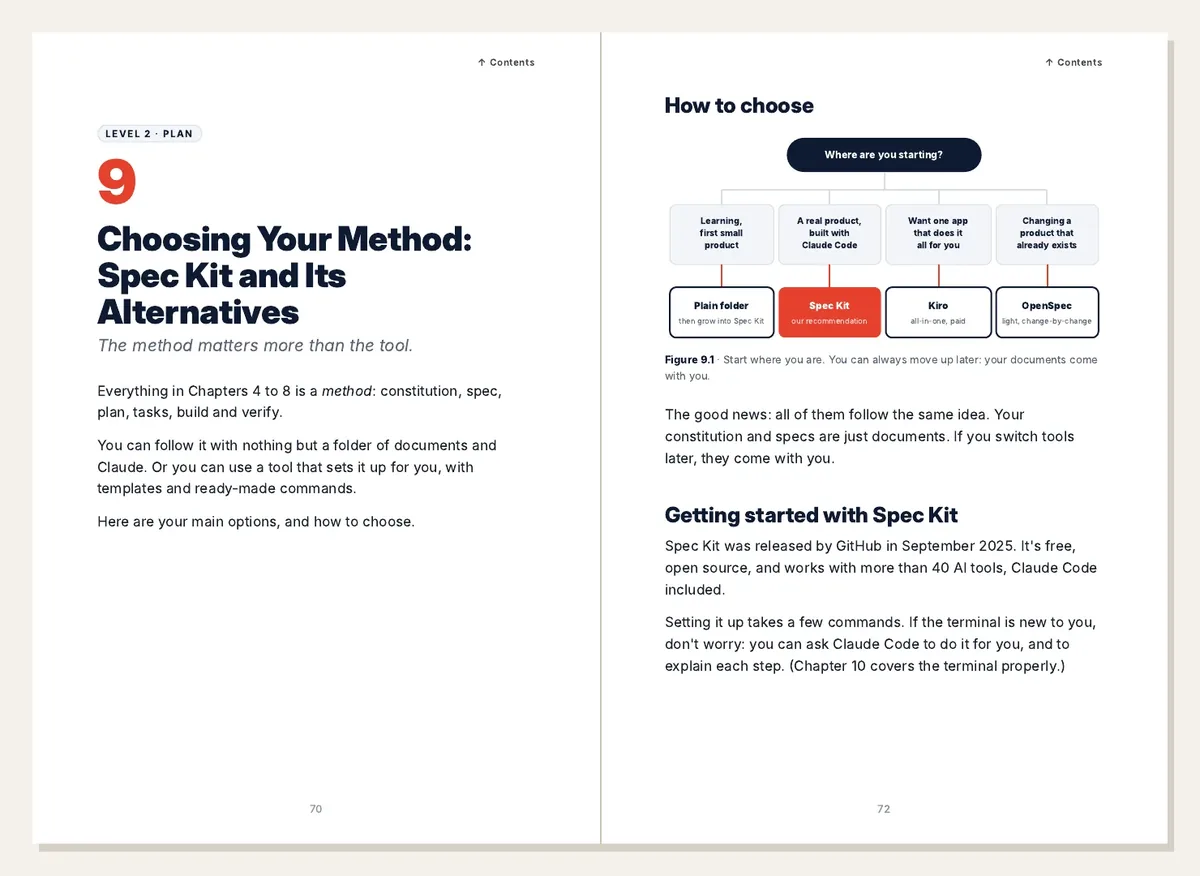
The good news: they all follow the same idea. Your constitution and specs are just documents. If you switch tools later, they come with you.
How do you switch from vibe coding to specs?
You don't have to start over. Start with five sentences.
Take the thing you're building and answer each question in one sentence:
- Who is it for?
- What problem does it solve for them?
- What's the first thing they do when they open it?
- What does success look like for them?
- What must never happen?
That's your first spec. Rough, and that's fine.
Then, before the AI builds anything, use this prompt:
"[Describe the task.] What is your understanding, concisely, in bullets? What is your implementation plan? After proposing the plan, stop and ask for my approval."
Misunderstandings now show up before any code exists, not after.
For the full step-by-step method, start with How to Build an AI App Without Coding.
The habit that makes Spec-Driven Development work
Here's the secret most people miss.
When something goes wrong, you don't just fix it. You write it down as a rule.
The AI reads that rule every time it builds. So the same mistake doesn't come back.
That's what happened with SiteNeuro. Every serious mistake became a written rule. The most important rules became automatic checks: if new code breaks one, the build stops before anything goes live.
The early months were full of repeat bugs.
The rules are why the later months weren't.
That's the real difference between the two approaches. A vibe-coded project gets harder to change every week. A spec-driven one gets easier, because every lesson is saved.
I wrote the whole method down for people who don't code: Build Your AI Platform.
Straight answers
What is the difference between vibe coding and Spec-Driven Development?
Is vibe coding bad?
Who coined the term vibe coding?
What is a spec in software development?
Do I need Spec Kit to do Spec-Driven Development?
Can non-developers use Spec-Driven Development?
Build your AI platform
The whole method, step by step, by a founder who is not a developer. Read Chapter 1 free first.
The Book $29 $19
244 pages. From your first idea to paying customers.
- 29 chapters in five levels
- Three complete builds
- A 30-day build challenge
- Templates, checklists, prompts, glossary
Book + Builder Kit $49 $39
The book, plus your first project set up for you.
- Everything in the book
- Starter project, ready for Claude Code
- 4 Claude skills and 6 guides
- Free updates
Founding price, for a limited time.