Getting Found
We Scored 605 Local Business Websites. Here's What the Weak Ones Get Wrong

How good are local business websites, really? Using Neuro, SiteNeuro's website scoring system, we scored 605 websites belonging to well-reviewed local businesses across Texas, Florida, Arizona, North Carolina and Indiana. About 1 in 5 (19.7%) scored below 45 out of 100. The average was 57.5.
And these weren't struggling businesses.
Every one had at least a 4.0 rating on Google and 10+ reviews. Four in five had 4.5 stars or more and 50+ reviews (482 of the 605).
So their customers love them.
But a lot of their websites don't show it.
Here's what we found, which industries are furthest behind, and the three basics the weak sites keep missing.
The headline numbers
- 605 local business websites scored, on a 0–100 scale
- 57.5 average score (median 62)
- 19.7% scored below 45, our line for a website that's actively underperforming
- About 1 in 6 (17.0%) businesses with 4.5+ stars and 50+ reviews still had a website below 45
- Only 5.9% of sites with recorded weaknesses had a mobile problem among them
That last one surprised us.
Mobile is mostly solved. The problem has moved. It's no longer "does it work on a phone?" It's "does it tell me what you do, and how to reach you?"
What the score measures
Every site was scored 0–100 against the same seven criteria. They aren't equal: the things that decide whether a visitor can use the site and act on it carry the most points.
| Criterion | Points | What it looks at |
|---|---|---|
| Mobile usability | 25 | Is the page set up for phones? Can you navigate and tap the buttons? |
| Page speed and performance | 20 | How heavy and slow the page is likely to be (estimated, see below) |
| Design and visual quality | 15 | Does it look current and professional? (estimated, see below) |
| Content quality and completeness | 15 | Services, service area and key details, in real words |
| Calls to action | 10 | A clear button, a contact form, a visible phone number |
| SEO basics | 10 | A descriptive page title, clear headings, a preview image for sharing |
| Overall experience | 5 | How well it all fits together |
| Total | 100 |
How the scoring works: Neuro, SiteNeuro's website scoring system, read each homepage's code: its title, headings, navigation, buttons, forms, phone number, mobile setup, amount of text and review widgets. It then scored each criterion against the rubric above, using Anthropic's Claude model.
What it doesn't do: Neuro doesn't load the page in a browser, time it, or look at it. So the speed and design points (35 of 100) are Neuro's estimates from the code, not measurements. That's why this study reports no speed or design findings.
Why 45 is the line: below 45, a site is missing basics, not just polish. The estimated criteria are worth only 35 points, so any site under 45 has lost at least 21 of the 65 points for mobile, content, calls to action, SEO and overall experience, whatever its speed and design estimates were.
How the scores were spread
| Score | Sites | Share |
|---|---|---|
| 0–29 | 49 | 8.1% |
| 30–44 | 70 | 11.6% |
| 45–59 | 143 | 23.6% |
| 60–74 | 342 | 56.5% |
| 75–100 | 1 | 0.2% |
A word on that last row.
Our scale is strict. Only one site out of 605 cleared 75, which says as much about the scale as about the sites. So read the scores relatively, and focus on the weak end. Below 45, the problems are not a matter of taste. They're missing basics.
Which industries are furthest behind?
This is where it gets interesting.
Curious what yours would look like?
Local business or professional — Neuro builds your site from your own data in about 60 seconds.
Build my demo in 60 seconds →

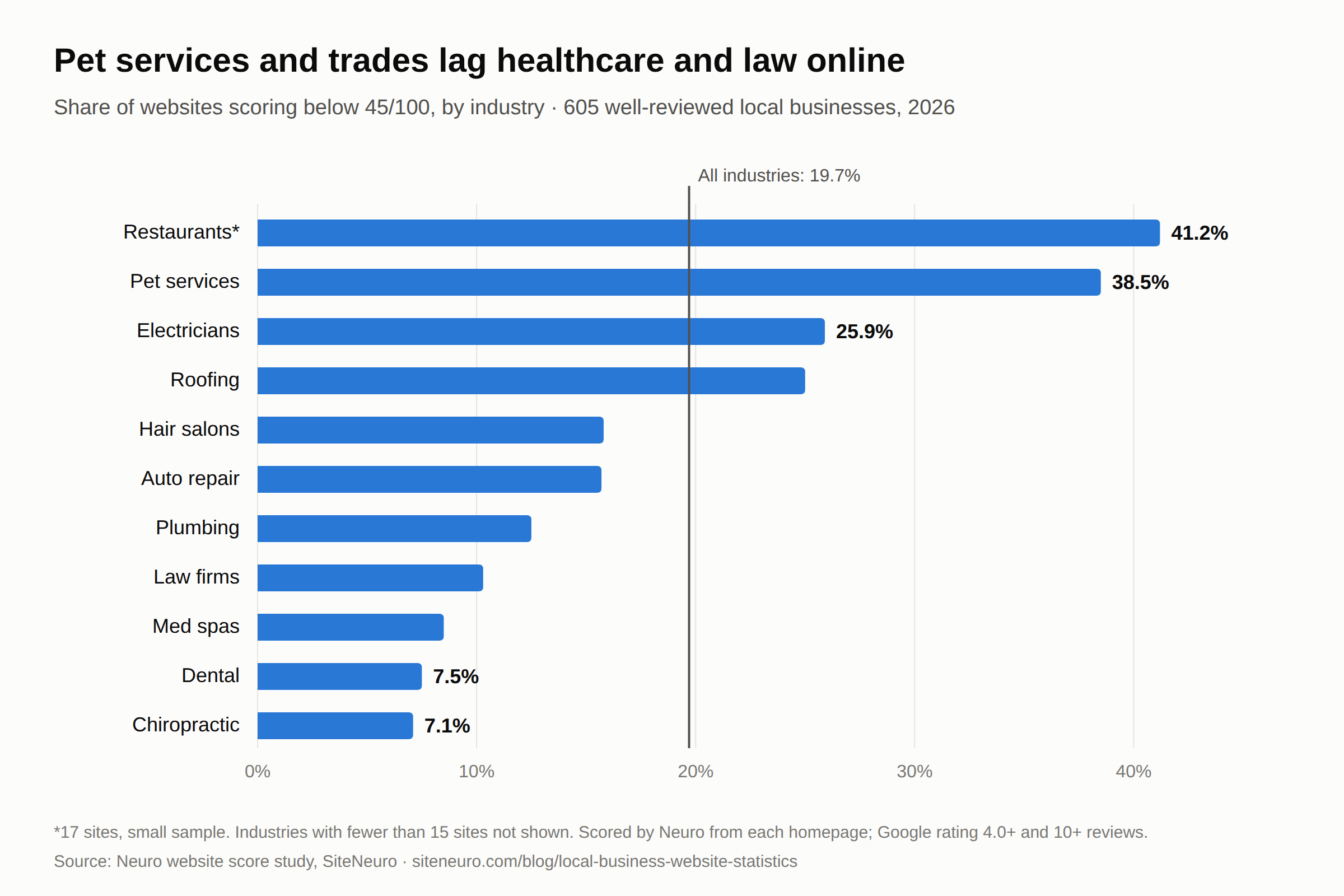
Free to republish with a link to this page: download the chart (PNG).
| Industry | Sites | Average score | Share below 45 |
|---|---|---|---|
| Restaurants* | 17 | 46.1 | 41.2% |
| Pet services | 91 | 51.8 | 38.5% |
| Electricians | 85 | 56.9 | 25.9% |
| Roofing | 24 | 51.4 | 25.0% |
| Hair salons | 38 | 58.0 | 15.8% |
| Auto repair | 121 | 58.6 | 15.7% |
| Plumbing | 32 | 60.2 | 12.5% |
| Law firms | 29 | 63.1 | 10.3% |
| Med spas | 47 | 60.3 | 8.5% |
| Dental | 53 | 61.7 | 7.5% |
| Chiropractic | 42 | 62.2 | 7.1% |
\Small sample. Treat it as a signal, not a verdict.*
Pet services and trades lag healthcare and law by a wide margin.
A pet groomer or boarding business in our sample was about five times as likely to have a weak website as a dentist or chiropractor (38.5% vs. 7.5% and 7.1%).
Why?
Our read: dental, chiropractic and law practices often pay an agency or use an industry website provider. Groomers, electricians and roofers are more often busy owner-operators who built a site once and never touched it again.
That's also the opportunity.
In the industries where most sites are weak, a clear, basic website stands out fast.
(Want city-level detail? We've published deep dives on restaurants in Kissimmee, plumbers in Tyler and law firms in Mesa.)
What the weak sites get wrong
For 222 of the sites, Neuro also recorded the three biggest weaknesses. We grouped them by theme.
| Weakness | Share of those sites |
|---|---|
| Thin or unclear content | 77.0% |
| Hard to contact (no form, phone not prominent) | 76.1% |
| No clear call to action or booking path | 73.9% |
| Weak SEO basics (titles, headings, meta) | 67.6% |
| Missing trust signals (reviews, testimonials) | 47.7% |
| Mobile problems | 5.9% |
Notice something?
The top three are all about the same moment. A customer lands on the site, ready to act, and the site doesn't tell them what you do, why to trust you, or what to do next.
Let's take them one at a time.
1. Thin or unclear content
The site says "Quality service since 1998" and little else.
No list of services. No service area. No prices, or even a "starting at."
A customer can't tell if you do what they need. Neither can Google, or an AI assistant trying to recommend someone.
2. Hard to contact
The phone number is in tiny text in the footer. Or it's an image, so it can't be tapped.
There's no form. Or the form is three clicks deep.
Every extra step loses people who were ready to call.
3. No clear next step
The page never asks for anything.
No "Call now," no "Book online," no "Get a free quote" button where a thumb can reach it.
And nearly half hide their best asset
47.7% of these sites showed weak or missing trust signals. Remember, these are businesses with strong Google ratings. The proof exists. It's just not on the website.
Here's why reviews alone aren't enough without a website to send people to.
How to check your own website in 5 minutes
Open your site on your phone and ask:
- Can I tell what you do and where, in 5 seconds? If not, rewrite the top line: service + city.
- Can I call you with one tap? The phone number should be a tappable link near the top.
- Is there one obvious button? "Call now," "Book," or "Get a quote." Pick one.
- Are your reviews visible? Your rating and 2–3 real reviews, on the homepage.
- Does every service have its own words? Even a short paragraph each helps customers, Google and AI assistants.
For the full list, see what every local business website needs.
How we did this study
- Who: 605 websites of local businesses in Texas, Florida, Arizona, North Carolina and Indiana, collected in 2026, across the industries in the table above. Every business had a Google rating of 4.0+ and 10+ reviews. It's a sample of well-reviewed local businesses, not of all businesses.
- How: Neuro, SiteNeuro's website scoring system, scored each homepage's code 0–100 on the seven weighted criteria in What the score measures, using Anthropic's Claude model.
- Limits: we read each homepage's code; we didn't time page loads or judge visual design by eye, so we don't report speed or design findings. Weakness themes come from the 222 sites where the top three weaknesses were recorded. Industry and state groups under 15 sites are not reported.
Journalists and researchers: you're welcome to use these figures with a link to this page. For the underlying data or a custom cut, contact us through our press page.
Frequently asked questions
What percentage of small business websites are bad?
How were the websites scored?
What is the most common problem with small business websites?
Do good Google reviews mean a business has a good website?
What should a local business website have on the homepage?
How can I improve a weak small business website quickly?
See what Neuro would build for you
Build your demo from your own data in about 60 seconds — then watch your AI team take it live and grow it.
Build my demo in 60 seconds → Explore the showcaseJust need the website itself — no ongoing marketing? See Essential — $39/year →