Build With AI
Non-Technical Founder, No Co-Founder: How I Built It Anyway With Claude Code
No technical co-founder? In 2026 that no longer has to stop you. Here's how we built a live AI platform with Claude Code anyway.
Can a non-technical founder build a product without a technical co-founder? In 2026, yes.
I built SiteNeuro, a live AI platform, without one, using Claude Code and Spec-Driven Development.
You still need to understand how your product's logic works and lead it like an architect, but Claude can do the coding and act as your always-on technical partner.
In June 2025, I had an idea.
I was travelling, and I kept seeing great local businesses on Google Maps with hundreds of five-star reviews and no website.
That became SiteNeuro.
I'm a mechanical and industrial engineer with an MBA.
Ten years in UI design, writing and business development.
Not a developer.
So I did what founders are told to do. I found technical partners.
It didn't work out.
Here's what happened next, and what I'd tell any founder in the same spot.
Why I wanted co-founders
I believe in partnerships. One plus one can be more than two.
Everyone has strengths, and the right team creates something none of them could alone.
And SiteNeuro is a technical, code-hungry product. It finds and scores local businesses, generates their websites, runs an AI assistant on them and keeps marketing going after launch.
Before Claude and Spec-Driven Development, I could never have built it myself. That was simply true.
Why no-code wasn't enough
My first attempt was a no-code automation tool, n8n.
It looked like the answer: connect the boxes, build the logic, no programming.
In practice, it was still complicated. Real workflows needed Python, API knowledge and much more than connecting the dots. Designing the logic was only half the job.
And even with an experienced senior engineer as a partner, some parts of the product needed skills neither of us had.
The project stalled.
The Claude Code moment
Then came early 2026.
Q1 2026 was the Claude Code moment for coding, the way Q4 2022 was the ChatGPT moment for AI.
In March 2026, I decided: Claude is ready now.
I went back to SiteNeuro and built it, mainly myself, with Claude Code and Spec-Driven Development. I treated it as a school: the best way to understand how products get built in the AI era was to build one.
Over about 175 working days and roughly 1,000 hours, we merged 1,156 changes. SiteNeuro has been live for more than two months and has built more than 1,000 websites.
What changed when I built alone
The honest feeling was relief.
The book
Become the architect. Let Claude be your CTO.
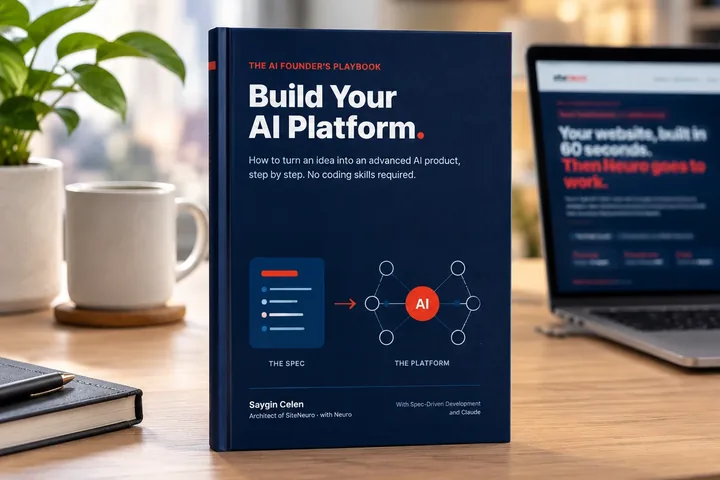
Build Your AI Platform shows non-technical founders how to build real products with Claude and Spec-Driven Development. Chapter 1 is free.
- 29 chapters, five levels, step by step
- Three complete builds, start to finish
- Templates, checklists and a prompt kit
- Chapter 1 is free to read, in full
I've been an entrepreneur for a long time. Building alone with Claude meant my speed depended on my own learning and effort, not on how another person's skills, schedule and priorities lined up with mine.
There were plenty of sleepless nights.
But I had something no solo founder had before: a building and brainstorming partner available 24/7. Claude was there at 2am when a bug appeared, and there at 7am to plan the next feature.
Do you still need co-founders?
Co-founders are still valuable. They share the workload, and the right one brings perspective and support.
But you need them much less than you used to.
If you build the system right, Claude and a team of AI agents can handle a remarkable share of the work:
- Coding: building features from your specs
- Design: layouts, prototypes and visuals
- Marketing: drafts of posts, emails and pages
- Brainstorming: a thinking partner that challenges your plans
One person can now build what used to take a team of ten senior engineers, marketers and designers. Not because the person does ten jobs, but because they lead a system that does.
Technical co-founder vs. Claude + Spec-Driven Development
| Technical co-founder | Claude + Spec-Driven Development | |
|---|---|---|
| Availability | Their schedule and energy | 24/7 |
| Skills | Deep in their specialties, gaps elsewhere | Broad: code, design, writing, planning |
| Equity | Often a large share of the company | None |
| Pace | Set by two people's alignment | Set by how fast you learn and decide |
| What you must bring | Shared vision, trust | The architecture, clear specs and testing |
| Biggest risk | The partnership ends | Building without understanding your own product |
What I'd tell a founder whose technical co-founder just left
You don't need a technical co-founder anymore if you build with Spec-Driven Development and Claude.
But there's a condition.
You need to learn how your product's logic works. Not every line of code, but how the parts fit together, what depends on what, and what "working" means.
You become the architect. Claude becomes your CTO and strategist.
Think of yourself as the conductor of a symphony orchestra. You don't play every instrument. You know the score, you set the tempo, and you hear immediately when something is off.
Here's where to start:
- Write the score first. Spend a week on your specs: goals, rules, what you want and what you don't. (My workflow is in Claude Code for non-developers.)
- Build in small pieces. One feature, tested, before the next.
- Test like a customer, on the devices your customers use.
- Turn every mistake into a rule so it never comes back.
- Keep learning the logic. Ask Claude to explain how things connect until you could draw it on a whiteboard.
The longer version of the method is in how to build an AI app without coding, and the story behind the book is in why I wrote Build Your AI Platform.
Straight answers
Can a non-technical founder build a startup without a technical co-founder?
Is no-code enough to build a real product?
What does Claude do as a "CTO"?
Do I still need co-founders in the AI era?
What should I do if my technical co-founder leaves?
Build your AI platform
The whole method, step by step, by a founder who is not a developer. Read Chapter 1 free first.
The Book $29 $19
244 pages. From your first idea to paying customers.
- 29 chapters in five levels
- Three complete builds
- A 30-day build challenge
- Templates, checklists, prompts, glossary
Book + Builder Kit $49 $39
The book, plus your first project set up for you.
- Everything in the book
- Starter project, ready for Claude Code
- 4 Claude skills and 6 guides
- Free updates
Founding price, for a limited time.