Websites by Industry
Plumbing Website Design: What 32 Plumbing Company Websites Show
Plumbing websites beat most trades. But a plumber's site has one job the others don't: turning a 2 a.m. emergency into a phone call. Here's what the stronger ones do.
What does good plumbing website design look like? A site that lets someone with water on the floor call you in one tap, and tells them, before they do, that you cover their area and fix their problem.
Plumbing websites are better than most trades'.
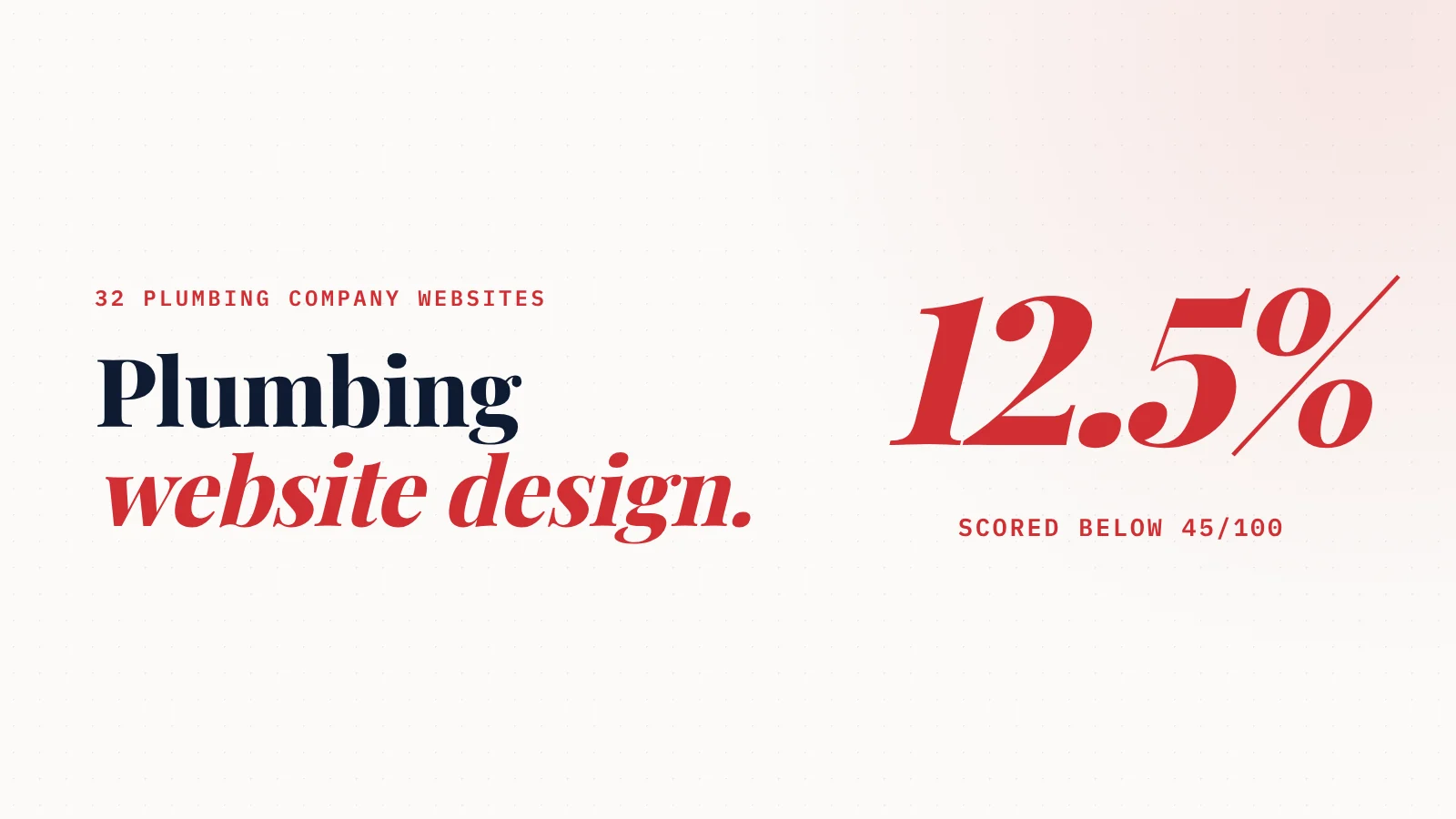
SiteNeuro scored the websites of 32 well-reviewed plumbing companies.
They averaged 60.2 out of 100, ahead of electricians, roofers and auto repair shops.
12.5% scored below 45. That's about 4 companies in 32, against 19.7% across all industries.
So the question for a plumber isn't "is my site broken?"
It's "does my site win the call when someone has three plumbers open in three tabs?"
Here's what the numbers say, what the stronger sites do, and a checklist built for plumbers.
The numbers: 32 plumbing company websites
From SiteNeuro's October 2026 study of 605 well-reviewed local businesses in Texas, Florida, Arizona, North Carolina and Indiana:
| Plumbing companies in the study | |
|---|---|
| Websites scored | 32 |
| Average website score | 60.2 / 100 (all industries: 57.5) |
| Scored below 45 | 12.5%, about 4 companies (all industries: 19.7%) |
| Google rating | Every company had 4.0+ stars and 10+ reviews |
How plumbing compares with the other trades in the study:
| Trade | Sites | Average score | Share below 45 |
|---|---|---|---|
| Plumbing | 32 | 60.2 | 12.5% |
| Auto repair | 121 | 58.6 | 15.7% |
| Electricians | 85 | 56.9 | 25.9% |
| Roofing | 24 | 51.4 | 25.0% |
A plumbing company in the study was about half as likely to have a weak website as an electrician or a roofer.
A separate, city-level look at 18 plumbing websites in Tyler, TX averaged 55, so a good industry average still leaves plenty of local sites behind.
The October study did not break average ratings or review counts out by industry. The next run of the study will, and this page will be updated with them.
Why plumbing sites score better, and why that's not enough
The study measures the gap. It doesn't ask owners why.
Our read: plumbing is a high-ticket, competitive trade. Many companies pay for a website and for ads, and a paid site usually gets the basics right.
But "better than average" is a low bar when the customer is standing in an inch of water.
A plumbing website isn't judged against other industries. It's judged against the two plumbers in the next tabs.
That's where the details below decide who gets the call.
What the score measures (and what it doesn't)
What it reads: Neuro, SiteNeuro's website scoring system, reads each homepage's code: its title, headings, navigation, buttons, forms, phone number, mobile setup, amount of text and review widgets.
How it scores: it rates the site 0–100 against the same seven weighted criteria every time, using Anthropic's Claude model: mobile usability (25 points), speed (20), design (15), content (15), calls to action (10), SEO basics (10) and overall experience (5).
What it doesn't do: it never loads the page in a browser or times it. So the 35 points for speed and design are estimates from the code, not measurements.
Why 45 is the line: a site under 45 has lost at least 21 of the 65 points for mobile, content, calls to action and SEO. Below 45, basics are missing, not polish.
The full method is in the study of 605 local business websites.
Where weak plumbing sites fall short
For 222 sites in the study, Neuro recorded the three biggest weaknesses.
Those are counted across all industries; the October study did not split them out by industry. Here's how often each came up:
| Weakness | Share of those sites |
|---|---|
| Thin or unclear content | 77.0% |
| Hard to contact (no form, phone not prominent) | 76.1% |
| No clear call to action or booking path | 73.9% |
| Weak SEO basics (titles, headings, meta) | 67.6% |
| Missing trust signals (reviews, testimonials) | 47.7% |
| Mobile problems | 5.9% |
On a plumbing site, those look like this:
Hard to contact: the phone number sits in the footer, or in an image that can't be tapped. On a phone, at night, that's a lost call.
No call to action: "Welcome to our family-owned business" where "Call now: 24/7 emergency plumbing" should be.
Thin content: "Residential and commercial plumbing" and nothing else. Someone with a leaking water heater can't tell whether you do water heaters.
Hidden trust: hundreds of five-star reviews on Google, and none of them on the website.
What the stronger plumbing sites do
The study ranks sites; it doesn't name them. But the score is built from fixed criteria, so a site at 60 or above earned its points the same way.
Your growth partner
A website is the start. Neuro keeps it working.
- Built from your Google or LinkedIn
- Answers visitors, captures leads
- Drafts blog, social and newsletter
- Nothing goes out until you approve it
Rated Excellent on TrustpilotGlobal review platform · 300M+ reviews

On a plumbing site, that looks like:
- The headline names the job and the town. "Emergency plumber in Tyler, TX" beats "Quality Service Since 1998."
- A tap-to-call number at the top of every screen on a phone, not just in the footer.
- Each main service written out: leaks and burst pipes, drain cleaning, water heaters, sewer lines, fixtures. One line each on what you do.
- The service area stated plainly, by town or zip code.
- Real reviews on the page, especially ones that mention speed, cleanliness or a fair price.
- The basics are tagged for search: a page title with the service and city, clear headings and a preview image.
What every plumbing website needs
Most plumbing searches are urgent. Each item below answers a question the customer has before they call.
- A tap-to-call phone number, big, at the top, and repeated after each section.
- Your hours, and whether you take emergency calls. If you're 24/7, say it in the headline. If you're not, say when you answer.
- Your services, one by one, so a search for "water heater repair" finds a page that says "water heater repair."
- Your service area, town by town, so people outside it don't waste a call and people inside it know you'll come.
- How pricing works: a service-call fee, free estimates, or upfront quotes. Owners don't expect a full price list for plumbing, but they want to know how you charge.
- Licensing and insurance: your license number where your state issues one, and that you're insured.
- Real reviews on the homepage, with the reviewer's first name and town.
- Photos of your real team and trucks, not stock photos of a smiling model with a wrench.
- A short request form for non-urgent jobs (name, phone, the problem, preferred time), for people who'd rather not call.
- Address, hours and a map, so Google and AI assistants can match you to "plumber near me."
If you only fix three things this week, make them a tap-to-call number at the top, a list of your services, and your service area in plain words.
For getting more of those calls beyond the website, see how plumbers get more customers.
What a plumbing website costs (October 2026)
Four ways to get one, with the prices used in SiteNeuro's small business website cost guide:
| DIY builder | Web designer or agency | AI website builder | SiteNeuro Essential | |
|---|---|---|---|---|
| Example | Wix Light, Squarespace Basic | Freelancer or small agency | Durable Launch | SiteNeuro Essential |
| Cost | About $213–$228 a year | Roughly $3,000–$12,000 upfront for a simple site | $264 a year | $39 a year + your domain (usually $10–15) |
| Who builds it | You | A professional | AI drafts it; you edit | AI builds it from your Google listing; you edit |
| Time to a live site | A weekend to a few weeks of evenings | Usually weeks | Minutes to a first draft | Minutes; you see it free before paying |
| Strong at | Full control, add-ons | Custom design, a page per service, copywriting | A fast start | Your real reviews, photos and services from day one, tap-to-call, search markup |
| Weaker at | Your time, and starting from a blank page | Cost; changes go through someone else | Generic copy until you rewrite it | One page, so no separate page per service; fewer design controls than a builder |
| Best for | Owners who enjoy building | Multi-truck companies with an ad budget | Owners who want a draft to edit | Owners who want a solid site live this week |
If you run paid ads, a separate page for each service usually matters more, and that points toward a designer or a builder you control.
See a live example
SiteNeuro doesn't have a plumbing showcase site it can show yet.
And it won't put a real business's website on display without the owner's say-so.
So the honest option is your own: see a demo built for your own business → It's free, it uses your Google listing, and it takes about a minute.
Other industries, for comparison: pet grooming website design, where 38.5% of sites scored below 45, and auto repair website design, at 15.7%.
Not a plumber? The same three fixes apply
Plumbing makes the point sharply because the customer is in a hurry. But anyone who gets called in a hurry is judged the same way: electricians, HVAC, locksmiths, towing, cleaners, garage door repair, even a dentist with a patient in pain.
The same three fixes work for all of them:
- A number people can tap, at the top of the page on a phone.
- Your services named on the page, in the words customers search for.
- Where you work, in plain words: your towns, your hours, and whether you take urgent calls.
For the full picture across 11 industries, see the study of 605 local business websites, and for a checklist that fits any business, what every local business website needs.
The bottom line
Plumbing websites are ahead of most trades: an average of 60.2 out of 100, and only 12.5% below 45.
But the customer isn't comparing you with dentists. They're comparing you with the plumber in the next tab.
A number they can tap, the job they need named on the page, and the town they live in. Get those three right, and you win the call.
Straight answers
What should a plumbing website include?
How good are plumbing company websites, on average?
Should a plumber list prices on the website?
Does a plumber need a separate page for each service?
What matters most on a plumbing website for emergency calls?
How much does a plumbing website cost?
Can SiteNeuro build a plumbing website?
Ready to put this to work?
Pick how much help you want. Both start with a free look at your site.
Essential $39/year
Just the website, done properly.
- Built from your Google or LinkedIn
- Set up for Google and AI search
- Hosting and security included
- Unlimited edits, no extra cost
Apex Concierge $119/mo
Your website, plus a growth team every week.
- Your site in your inbox within 2 hours
- 30-minute setup call with a specialist
- Answers visitors, captures leads
- Drafts blog, social and newsletter
Rated Excellent on TrustpilotGlobal review platform · 300M+ reviews