AI Insight
Claude Duet and the Always-On Agent Race: What It Means for a Small Business
AI that works while you sleep is here, from three companies at once. What it really does, what's hype, and what to hand over first.
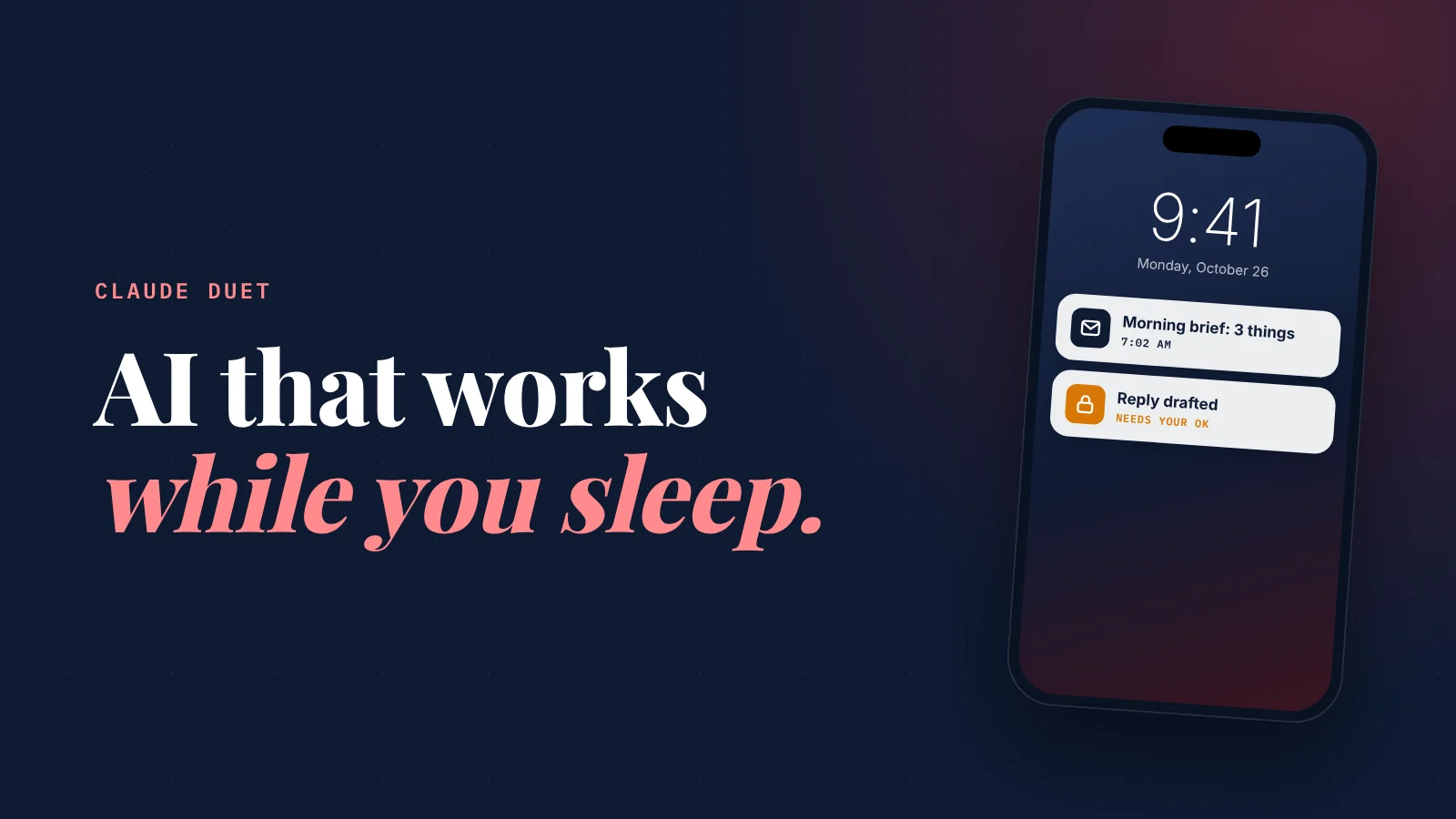
What is Claude Duet? It's Anthropic's new AI agent that works for you in the background, even when your phone and laptop are off.
It checks your apps, sends you a morning brief, and asks before it does anything that matters.
It's not alone.
In a few weeks, Meta, OpenAI and Anthropic have all launched the same idea: an AI that keeps working after you close the chat.
Here's what Duet actually does, how the three compare, what's hype, and what I'd hand over first if I ran a small business.
Full disclosure: I build with Claude every day and wrote a book about it, so weigh my view accordingly. Duet is a waitlist preview and I haven't used it yet. Everything below comes from Anthropic's own description and the first reporting.
What Claude Duet does
Anthropic announced Duet on October 21, 2026, as a research preview. It's built for, in Anthropic's words, "professionals and small business owners with more on their plates than they can track."
The short version:
- It has its own computer. Duet runs on a virtual machine in the cloud, with its own browser. It keeps working when your devices are off.
- It knows your setup. It carries over your memory, skills and connected apps from your Claude account.
- It connects to your tools. Anthropic lists Gmail, Slack, QuickBooks, Stripe, Gusto, HubSpot, Docusign, Canva and Shopify among thousands of connectors.
- It briefs you every morning on what matters most across those apps.
- It checks in every few hours, and messages you only when something needs attention.
- You talk to it in one thread, by typing or voice. You describe a task; it picks the apps and steps, and tells you when it's done or needs a review.
It lives in its own app on iOS and Android, and on claude.ai.
What it won't do without you
This is the part that matters most.
Duet can read, draft and prepare on its own. Before it sends a message, makes a payment, signs a document or deletes anything, it shows you the action and waits for your OK.
Some things are off-limits even with your approval: it won't trade securities or move money between accounts.
It never directly sees your passwords or sign-in tokens. When it buys something, it uses a virtual card, so your real card number isn't shared.
And you can disconnect any app at any time.
Duet vs Muse vs Dots
Three companies, one idea, three different bets.
Your growth partner
A website is the start. Neuro keeps it working.
- Built from your Google or LinkedIn
- Answers visitors, captures leads
- Drafts blog, social and newsletter
- Nothing goes out until you approve it
Rated Excellent on TrustpilotGlobal review platform · 300M+ reviews
| Claude Duet | Meta Muse | OpenAI Dots | |
|---|---|---|---|
| Maker | Anthropic | Meta | OpenAI |
| Where it lives | Its own app, plus claude.ai | Meta's apps, the web and WhatsApp | Inside ChatGPT |
| Price | Included in Claude Pro and Max | Free to start, paid tiers at $20 and $100 a month | From the $100-a-month ChatGPT Pro plan |
| Who can get it | Waitlist, US Pro and Max first | US and Canada | ChatGPT Pro and business plans |
| Built for | Professionals and small business owners | Everyday users | Professionals and developer teams |
xAI has its own version too: Grok Bot, launched in August.
How I'd read the table:
- Muse is the cheapest way to try the idea, built for personal life more than for running a business. It also separates what the agent may read from what it may change, a sensible design for a first try.
- Dots makes sense if your work already lives in ChatGPT and you're paying for Pro.
- Duet is the one aimed squarely at owners: the connector list (QuickBooks, Stripe, Gusto, Shopify) reads like a small business's back office.
What's hype
Three things to keep in proportion.
1. "It works while you sleep" doesn't mean "it works without you." Every action that matters still waits for your approval. That's the right design, but it means you're the manager, not the retired owner.
2. It still makes judgement mistakes. Anthropic says so itself: Duet "can still misjudge what's urgent," and it may misread a thread. A morning brief that flags the wrong thing is still a brief you have to read critically.
3. Background work isn't free. Duet shares your plan's usage limits. Anthropic notes that more frequent check-ins use them up faster. An agent checking everything every hour is a cost, even when it's "included".
None of that makes it a gimmick. It makes it a research preview, which is exactly what Anthropic calls it.
What I'd hand over first
If I ran a café, a dental practice or a plumbing business, I'd start with jobs where a mistake is cheap and the time saved is real.
Hand over:
- The morning brief. Email and calendar only, for the first week. Read it every day and note what it got wrong.
- Drafts, not sends. Replies to enquiries and reviews, prepared for you to approve. You stay the voice of the business.
- Spotting conflicts. Double bookings, a supplier invoice due before a payment lands, a client call that clashes with travel. One of Anthropic's own examples is a broker's appointment that was on her calendar for the wrong day.
- A weekly numbers summary from your accounting or payments app, read-only.
Keep for yourself:
- Anything that moves money. Even where an agent can ask permission to pay, make paying a human habit.
- Payroll and banking. Don't connect them during a preview. Read-only summaries can come later.
- Customer data you'd hate to see in the wrong place. Connect the apps that need it, not every app you have.
And one rule from the website security guide applies to agents too: an email that asks for urgent action deserves a second look, whoever brings it to you.
What it changes for a small business
For twenty years, "work while you're not working" meant hiring someone.
This month, three of the biggest AI companies shipped a version you can try for $0 to $100 a month.
It won't run your business. But it can take the first pass at the inbox, the calendar and the numbers, so your attention goes to the decisions only you can make.
My advice: join a waitlist, start with read-only jobs, and judge it after two weeks by one question: did it save me time I'd otherwise have lost?
In a couple of weeks I'll publish the practical follow-up: the first three tasks to give an AI agent, with the exact settings to choose. Until then, the AI tools a small business actually needs are in the AI tools guide.
Straight answers
What is Claude Duet?
How much does Claude Duet cost?
How do I get Claude Duet?
What's the difference between Claude Duet, Meta Muse and OpenAI Dots?
Is Claude Duet safe to connect to my business accounts?
Can Claude Duet replace an assistant?
Ready to put this to work?
Pick how much help you want. Both start with a free look at your site.
Apex Concierge $119/mo
Your website, plus a growth team every week.
- Your site in your inbox within 2 hours
- 30-minute setup call with a specialist
- Answers visitors, captures leads
- Drafts blog, social and newsletter
Essential $39/year
Just the website, done properly.
- Built from your Google or LinkedIn
- Set up for Google and AI search
- Hosting and security included
- Unlimited edits, no extra cost
Rated Excellent on TrustpilotGlobal review platform · 300M+ reviews