Get More Customers
How Chiropractors Fill Their Appointment Book Online
How chiropractors get more patients online comes down to three things.
Show up for pain-specific searches like "back pain relief near me." Earn trust fast with real testimonials and clear credentials. And make the path to book an appointment as short as possible.
Because here's what makes chiropractic different from almost every other local business.
Most people searching for a chiropractor are searching while they hurt.
They're not browsing. They're not comparing five options over a weekend.
They're sitting at a desk with a locked-up lower back, or they just threw their neck out picking up a kid, and they want relief — today, if possible.
That changes everything about what "getting more patients" actually requires.
Why "near me" and pain-specific searches decide who gets the appointment
Think about what someone actually types when their back seizes up.
Not "chiropractor." Not even "chiropractic care."
They type the pain: "back pain relief near me." "neck pain doctor near me." "sciatica treatment near me."
The business that shows up for the pain, not just the profession, gets the click.
That's the first thing most practice websites get wrong. They lead with the practice's name and a stock photo of a spine. A hurting patient doesn't care about your logo. They care about whether you can fix this — right now.
So your site needs to speak in the same language your patient is searching in:
- "Same-week appointments for back pain"
- "Relief for sciatica, headaches, and sports injuries"
- "Walk-ins welcome for acute pain"
Say the pain out loud, early, in words a patient would type — that's both good SEO and good copywriting. It's the same reason why customers can't find you online so often comes down to this exact gap: the business is real and good, but the website is talking about itself instead of the problem the patient is trying to solve.
How to actually rank for "chiropractor near me"
Ranking for pain-specific, location-based searches isn't a mystery. It's mostly blocking and tackling that a lot of practices skip.
Start with your Google Business Profile. It's the single highest-leverage thing you own for local search. Keep your hours, phone number, and address exact — and matching your website exactly, word for word. Add photos of your actual office, not clip art. List your real services as categories and attributes, not just "chiropractor."
Then build service-specific pages or sections, not one vague "services" paragraph:
- Spinal adjustments
- Sports injury and athletic recovery
- Prenatal and pregnancy-safe care
- Auto accident and whiplash treatment
- Pediatric chiropractic care
Each one is its own small opportunity to rank for a different pain-specific search — "prenatal chiropractor near me" is a completely different search (and a completely different buyer) than "auto accident chiropractor."
Collect and respond to reviews that mention specifics. A review that says "Dr. Lee fixed my sciatica in three visits" does double duty — it builds trust with a human reader, and it reinforces the exact keyword-and-location signal search engines look for. More on this below, because it's worth its own section.
Keep your site fast and mobile-first. A patient searching for relief on their phone, mid-flare-up, will not wait for a bloated homepage to load. Slow pages get abandoned before they ever get read — which quietly costs you both the ranking and the appointment.
The trust signals patients need before they'll book
Booking a chiropractor is a health decision, not a haircut.
That means patients are doing more due diligence than they would for, say, a pizza order — even if it only takes them thirty seconds.
Here's what they're actually looking for, in roughly the order they look for it:
- Clear services. Do you treat my problem? Adjustments, sports injuries, prenatal care, auto accidents — spelled out, not implied.
- Real testimonials or relief stories. Not a generic five-star badge — an actual sentence from an actual patient describing what changed for them.
- Credentials. Who is treating me, and are they qualified? A name, a license, a photo, a bit of background.
- Insurance accepted. This is often the actual deciding factor, and it needs to be visible near the top of the page — not buried on a separate page patients have to go hunting for.
- An obvious way to book. One clear "Book an Appointment" action, visible on every screen, not a phone number the patient has to scroll to find.
Notice what's not on that list: a slick design. Patients aren't grading your site on aesthetics. They're scanning it for evidence that you're legitimate, that you treat what hurts them, and that a real person can vouch for you.
A patient in pain isn't shopping. They're looking for proof, fast — then a button to book.
Miss any one of those trust signals and a patient doesn't email you a question. They just leave and call the next name on the search results page.
Why a slow or confusing site loses patients who are already hurting
Put yourself in the patient's position for a second.
Curious what a chiropractic website like this looks like for you?
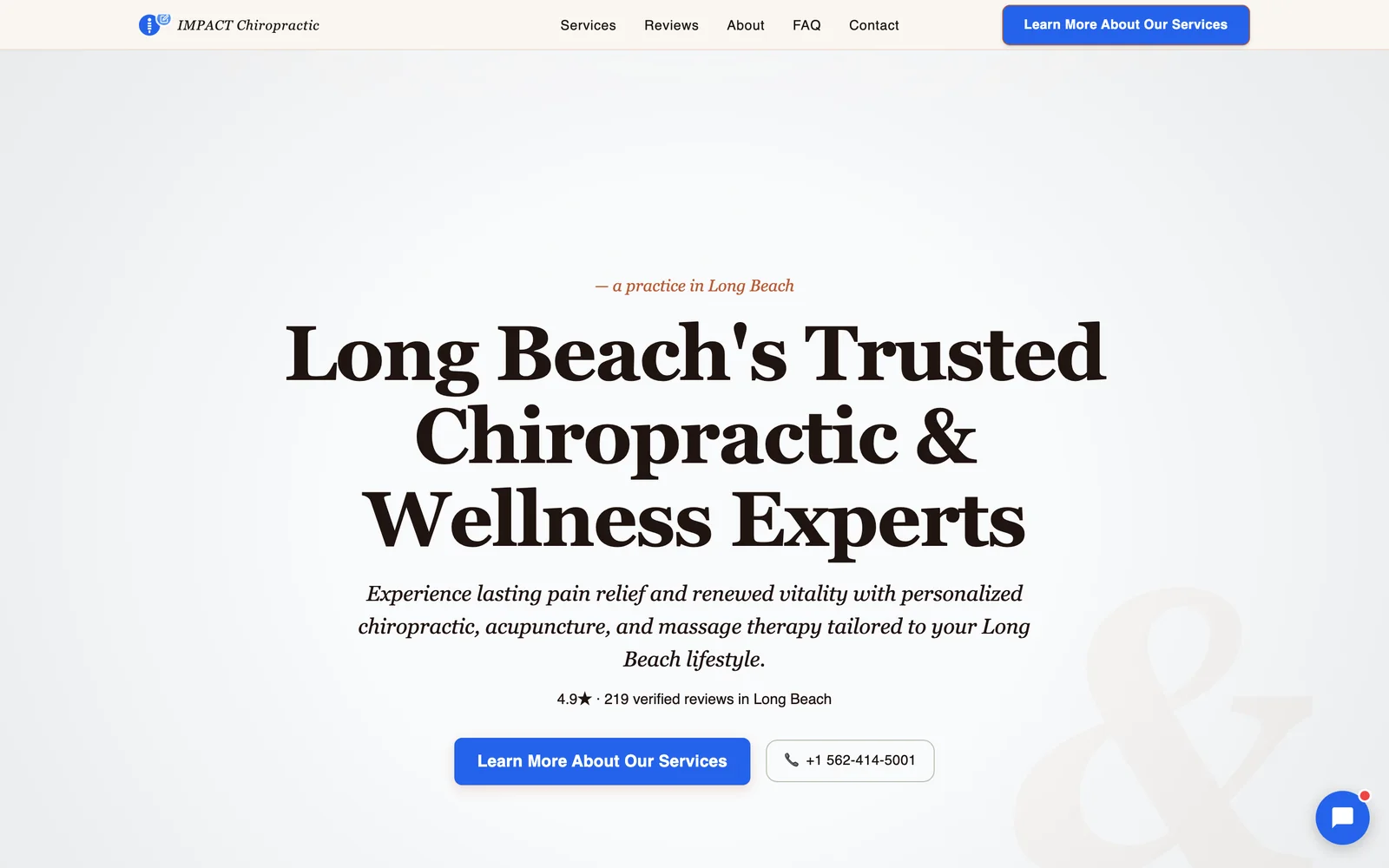
Neuro built IMPACT Chiropractic's site from their own Google data — yours can be next, in about 60 seconds.
Build my demo in 60 seconds →

Their back hurts. They found five chiropractors on Google. They have four browser tabs open.
Whoever answers their questions fastest wins the appointment.
That's not an exaggeration — it's the whole game. A confusing site with a "Services" dropdown three menus deep, a contact page with no phone number, or a booking form that asks for twelve fields before letting the patient hit submit — all of that quietly loses patients who would otherwise have booked.
The fix isn't complicated. It's discipline:
- One clear headline that names the pain you treat.
- Services, testimonials, and insurance info above the fold or one scroll down — not buried three clicks deep.
- A booking or call button that's visible from every screen, especially on mobile, since most of these searches happen on a phone.
- A page that loads fast. Every extra second is another patient who closes the tab and calls the next practice instead.
None of this requires a redesign. It requires ruthlessly cutting anything that isn't helping a hurting patient get to "yes, I trust this practice" and then "book now" as fast as possible.
Reviews are the compounding asset of a chiropractic practice
Of every local business category, chiropractic care might be the most reputation-driven of all.
Patients are trusting you with their spine, their headaches, their recovery from an accident. They will read your reviews before they read anything else on your site.
That makes review collection an ongoing job, not a one-time setup:
- Ask after the visit that actually worked. The moment a patient feels real relief is the moment they're most willing to leave a review describing it.
- Make it a one-tap link, not a scavenger hunt through Google's app.
- Respond to every review — good and bad. A thoughtful reply to a critical review often does more for trust than another five-star review would.
- Feature the best ones on your site, not just on Google. A specific relief story, in a real patient's words, does more convincing than any paragraph you could write about yourself.
Treat reviews like a second front door to your practice — one that keeps working for you long after the visit that generated it.
What this looks like when it's done right
A live example is worth more than a description, so here's one.
IMPACT Chiropractic is a real practice with a real demo site Neuro built. It's built from the practice's actual services and real reviews — pain-relief messaging up top, the specific services patients search for laid out clearly, and a one-tap path to book an appointment on every screen.
See the live IMPACT Chiropractic demo → — or browse more real practice sites in the showcase to see how the same principles play out for dental practices, gyms, and other trust-sensitive local businesses.
Whether you build it yourself, hire it out, or have Neuro generate a starting point from your Google profile, the checklist is the same one covered above: name the pain, prove you're trustworthy fast, and make booking a single obvious step.
The same logic carries over into other patient- and member-facing practices — the tactics that get dental practices more patients and the ones that help gyms get more members both come back to the same core idea: earn trust before you ask for the booking.
Curious how chiropractic sites are actually doing in a specific market? We scored a real sample: the best website for chiropractors in Charlotte, NC.
The bottom line
A hurting patient isn't shopping around for long.
They're looking for the practice that clearly treats their pain, has real people vouching for it, and makes booking effortless.
Get those three things right, and the appointment book fills itself.
Frequently asked questions
What's the fastest way for a chiropractor to get more patients online?
Do I need a blog to rank for "chiropractor near me"?
How important is showing insurance information on a chiropractic website?
Should I respond to negative reviews, or just ignore them?
What should a chiropractic website's homepage actually include?
Can Neuro build a chiropractic website like the IMPACT Chiropractic example?
See what Neuro would build for you
Build your demo from your own data in about 60 seconds — then watch your AI team take it live and grow it.
See a real chiropractic example: IMPACT Chiropractic
Build my demo in 60 seconds → Explore the showcaseWant Neuro running this for you every week? See Apex Concierge — from $119/mo →